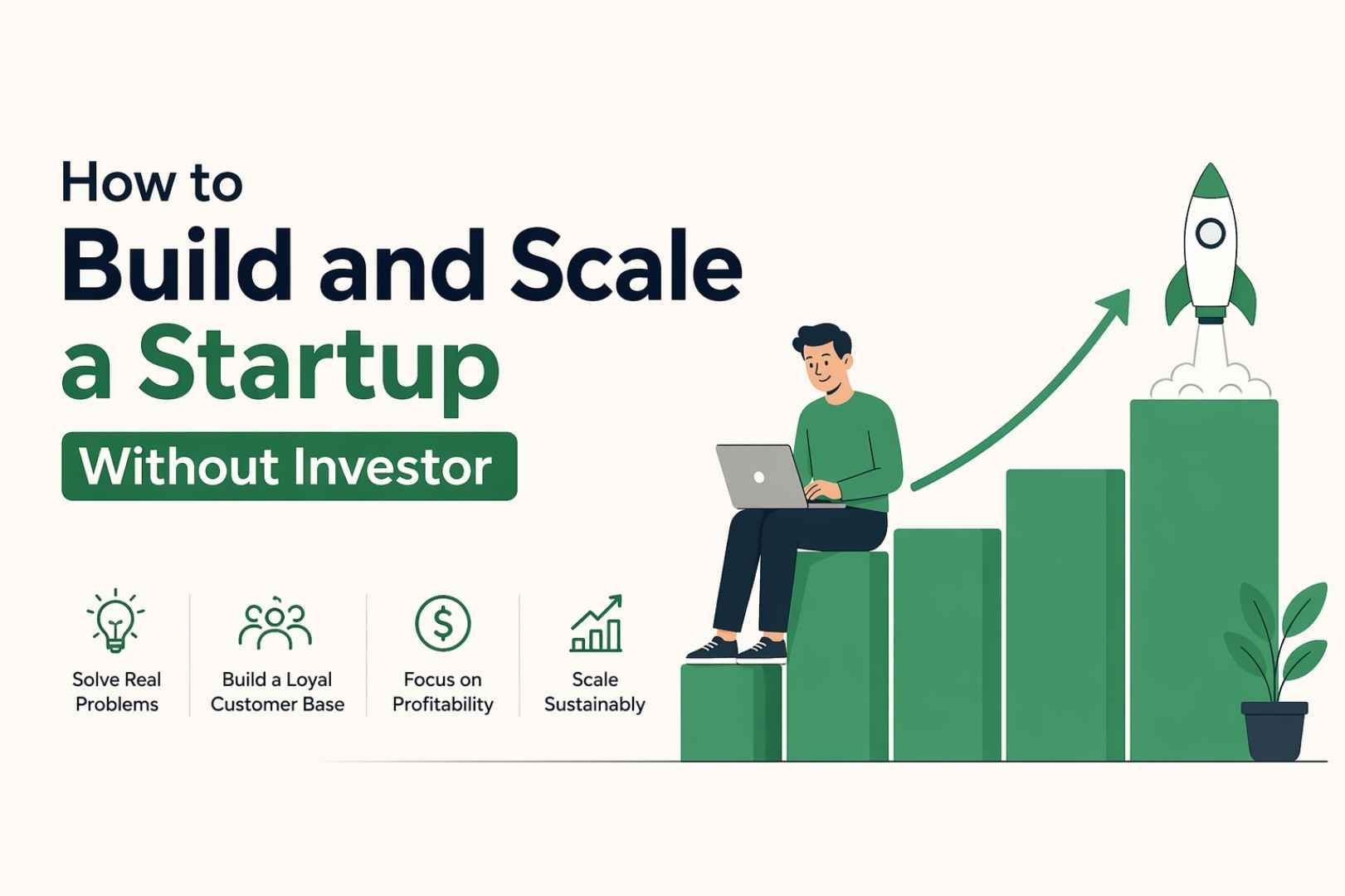
The conventional wisdom around startups has long revolved around one central goal: raise money. Pitch to investors, secure a seed round, burn through capital to grow fast, and hope that scale comes before the runway runs out. For decades, this was the playbook.
But something has shifted. In 2026, a growing number of founders are quietly building profitable, sustainable companies without ever sitting across from a venture capitalist. They are not doing it out of stubbornness — they are doing it because it works, and because the tools and conditions available today make it more viable than ever before.
This is not a guide about avoiding funding at all costs. It is a guide about understanding that revenue can replace capital as the engine of growth, and that building a business this way often leads to better outcomes — not just financially, but in terms of ownership, control, and long-term resilience.
Why Founders Are Rethinking the Funding-First Model
The traditional startup journey looks something like this: build a product, raise money to scale it, and grow aggressively before competitors catch up. Valuation becomes the metric of success, and every decision gets filtered through what investors expect to see.
This model has produced some remarkable companies. But it has also produced thousands of startups that raised significant capital, grew quickly, and then collapsed when they could not make the economics work. High valuations masked weak fundamentals. Growth masked poor unit economics. And founders who raised too much too early found themselves trapped — unable to adjust direction without board approval, and unable to exit without clearing a stack of investor preferences first.
The alternative path — building from revenue — flips this dynamic entirely. Instead of asking what investors want to fund, founders ask what customers are actually willing to pay for. Instead of optimizing for valuation, they optimize for margin. Instead of chasing growth at any cost, they build systems that generate consistent, predictable income.
The result is a business that survives because it earns its survival every month, not because someone else is subsidizing it.
Choosing the Right Market: Where Bootstrapping Actually Works
Not every business lends itself to a revenue-first approach. Some industries require enormous upfront infrastructure investment — physical manufacturing, deep R&D, hardware development — before a single dollar can be earned. In those cases, external capital is not optional; it is a structural necessity.
But for a large and growing portion of the startup landscape, especially in software, services, content, and digital products, the economics are genuinely different. The cost to build a usable product has dropped dramatically. AI tools can compress months of development into weeks. Distribution channels like search, email, and niche communities allow founders to reach paying customers without massive advertising budgets.
The markets where bootstrapping works best tend to share a few characteristics. There is an existing, demonstrable demand — customers are already spending money solving this problem, just in a worse or more expensive way. The problem being solved is urgent enough that someone will pay for a solution quickly. And the product can be delivered digitally or at low marginal cost, meaning each additional customer does not require proportionally more spending.
SaaS tools, B2B professional services, automation products, and specialized digital platforms consistently fit this profile. These are environments where a small team with strong execution can compete effectively without a war chest.
The First Revenue Is Your Most Important Milestone
Funded startups often treat revenue as a lagging indicator — something that matters later, once the product is refined and the user base is established. Revenue-first founders treat it as the very first goal.
There is a practical reason for this. When someone pays for your product, they are telling you something no survey, focus group, or investor pitch deck can tell you: that the solution you have built is worth more to them than the money in their pocket. That signal is irreplaceable. It eliminates guesswork and replaces it with evidence.
Getting to first revenue as quickly as possible is not about being greedy or cutting corners. It is about generating the clearest possible feedback on whether your idea actually solves a real problem at a price people will pay. If you can get a handful of customers to pay before you have built everything, you have already learned more than most funded startups learn in their first year.
This early validation also has a psychological effect. It builds confidence — yours and your customers’. It creates momentum. And it means that every subsequent decision about what to build next is grounded in real signals rather than assumptions.
Building a Self-Reinforcing Growth Engine
One of the most powerful aspects of building from revenue is that it forces you to construct a growth engine rather than simply a marketing funnel. The difference matters.
A funnel moves customers in one direction — from awareness to purchase — and has to be constantly refilled. A growth engine creates cycles. Customers who get genuine value become advocates. Advocates bring in new customers without you spending additional money. Revenue from existing customers funds acquisition of new ones. The system compounds.
Bootstrapped founders build these engines deliberately. They invest early in content that generates search traffic for months or years. They build communities around their product category, not just their product itself. They create email lists that they own and control, independent of any platform’s algorithm. They make referral programs a core feature rather than an afterthought.
Each of these assets becomes more valuable over time. And because they were built with discipline — without the option of simply spending more money to grow — they tend to be more efficient and more durable than paid acquisition strategies.
Pricing as a Strategic Weapon
Many founders, especially first-time ones, underprice their products. The logic feels intuitive: lower prices mean more customers, and more customers mean more growth. In practice, this often works against you.
Underpricing signals low value. It attracts customers who are price-sensitive rather than outcome-sensitive — customers who will leave the moment they find something cheaper. It compresses margins to the point where reinvestment becomes impossible. And it creates a ceiling on how much you can spend acquiring new customers, because each customer generates so little revenue that the math never works.
The founders who build durable bootstrapped businesses tend to charge based on the value they deliver, not the cost of what they built. They identify the specific, measurable outcome their product creates — time saved, revenue generated, cost reduced — and price accordingly. As the product improves and delivers more value, prices rise with it.
This is not about being expensive for its own sake. It is about building a business where the economics actually make sense: where each customer is genuinely profitable, where you can afford to deliver exceptional service, and where you have money left over to build the next version of the product.
The Role of AI in Making This All Feasible
In 2026, artificial intelligence has become the great equalizer for small founding teams. Tasks that previously required dedicated specialists — customer support, content creation, code review, data analysis — can now be handled by AI tools that cost a fraction of a human hire.
This is transformational for bootstrapped founders. The historical disadvantage of the small team was always capacity. You could not build fast enough, respond to customers fast enough, or produce enough content to compete with larger, better-funded teams. AI has substantially closed that gap.
A two-person team today can ship products and maintain operations that would have required eight or ten people just a few years ago. This means lower overhead, faster iteration, and more of each dollar of revenue available to reinvest in growth rather than salaries.
The founders who are winning with this approach are not using AI as a gimmick. They are embedding it deeply into their operations — using it to accelerate every part of the value chain while keeping the human judgment, creativity, and customer relationships that actually differentiate them.
Staying Lean: The Anti-Burn Philosophy
One of the quiet disciplines that separates bootstrapped founders from their funded counterparts is how they think about spending. In a funded startup, there is often an implicit permission to spend because the money is there. Hiring is easy to justify. Expensive tools accumulate. Office space, conferences, and overhead that would be unthinkable on a tight budget become standard.
Bootstrapped founders develop a different reflex. Every expenditure gets evaluated against a simple question: does this generate revenue, or does it make generating revenue easier? If the answer is no, it waits.
This is not about being cheap. It is about being deliberate. The discipline of lean spending does not just preserve cash — it builds habits of efficiency that persist even as the company grows. Founders who have learned to grow on limited resources tend to be better allocators when they have more.
It also creates genuine resilience. A company with low fixed costs and positive cash flow can survive almost any market downturn. A company burning through capital has a hard deadline on its existence.
Knowing When to Scale — and When to Wait
One of the most common mistakes in startup growth, funded or not, is scaling before the foundation is ready. Scaling amplifies whatever already exists in your business. If your retention is weak, scaling acquisition makes the leaky bucket problem worse. If your operations are chaotic, more customers create more chaos.
The bootstrapped approach to scaling tends to be more disciplined by necessity. Growth must be funded by existing revenue, which means it can only happen as fast as the business earns it. This constraint, while sometimes frustrating, acts as a natural regulator. You cannot outrun your unit economics.
The signal to start scaling aggressively is not a round of funding or a specific valuation — it is stability. When customers stay, revenue is predictable, margins are healthy, and the team is not constantly in crisis mode, the foundation is strong enough to build on. Scaling from that position creates compounding advantage rather than compounding risk.
Ownership, Exits, and the Long Game
There is a financial dimension to building without external capital that often goes underappreciated. When you raise venture capital, you are not just taking money — you are restructuring the ownership and incentive architecture of your business. Investors get preferred shares, protective provisions, and return expectations that may not align with what you want from the company.
A bootstrapped founder who owns the entirety of a business worth $10 million is in a fundamentally different position than a founder who owns 20% of a business worth $50 million. The numbers might look similar on paper, but the control, optionality, and ability to make decisions on your own timeline are completely different.
Bootstrapped founders can choose to sell when it suits them, to buyers they actually want, at valuations that reflect genuine profitability rather than projected growth. They can also choose not to sell — to run a profitable company indefinitely, taking income and building equity without ever needing an exit event. Or they can raise funding later, from a position of strength, with real leverage in negotiation because they do not need the money to survive.
The Mindset Underneath It All
Building without investors requires a particular kind of confidence. Not the bravado of assuming everything will work out, but the grounded confidence that comes from trusting your own judgment, making decisions based on evidence, and accepting full responsibility for outcomes.
Funded founders sometimes outsource their conviction to investors. If smart money is backing the idea, it must be worth pursuing. If the board approves the strategy, it must be the right one. This creates a kind of psychological dependency that can be limiting when conditions change and no one has a playbook for what comes next.
Bootstrapped founders have to develop their own judgment because there is no one else to defer to. Over time, this builds a depth of understanding about their business, their customers, and their market that is genuinely difficult to replicate. It is one of the reasons why many of the most durable, profitable private companies in the world were built without institutional capital.
Final Thought
Building a startup without investors is not easier than the traditional path. It requires discipline, patience, and the willingness to grow more slowly in the short term in exchange for far greater control and sustainability over time.
But in a world where the tools for building, distributing, and operating a software business have never been more accessible or affordable, the revenue-first approach is more viable than it has ever been. The founders who choose this path are not settling for less — they are choosing a different definition of success, one where the business they build actually belongs to them, and where growth is earned rather than borrowed.
The real measure of a startup is not how much it raised. It is how long it lasts, how much it earns, and how much of that value flows to the people who built it.
Also read:

Trust Post Desk
A journalist and editor at TrustPost.org covering world and national news, technology updates and human-interest stories. They check every fact, interview sources in person or online, and aim to deliver clear, accurate reporting. Their work ranges from breaking news to in-depth features and daily newsletters. Outside the newsroom, they follow emerging trends and engage with readers on social media.