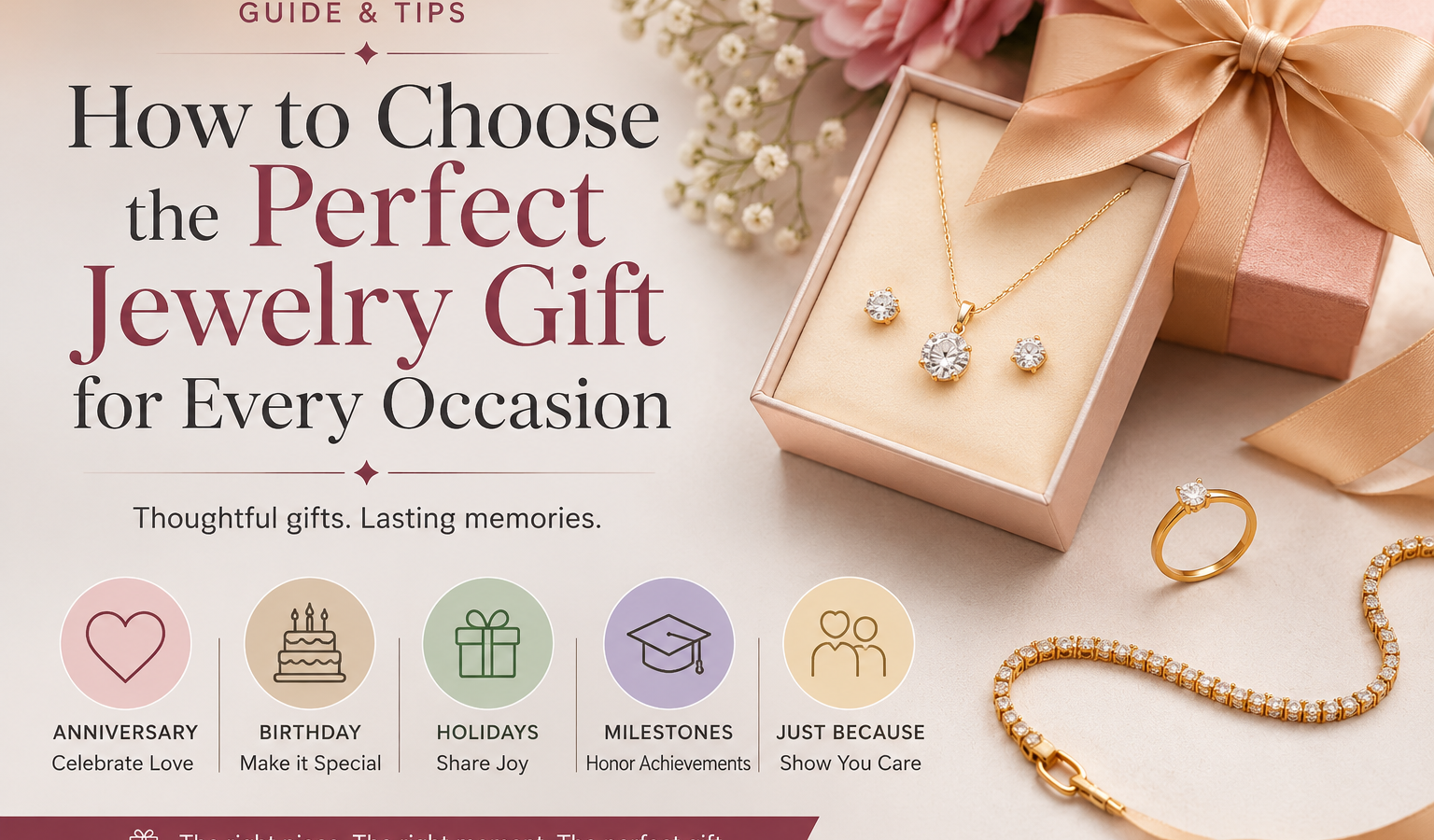
Jewelry occupies a strange and wonderful place among gifts. A well-chosen piece can outlast the occasion it marked by decades: it gets worn to work, to weddings, to hospital waiting rooms and anniversary dinners, quietly accumulating meaning with every year it’s on the body. A poorly chosen piece, on the other hand, ends up in a drawer within a month. The difference rarely comes down to price. It comes down to whether the giver understood the occasion, the recipient, and the practical details that make a piece wearable for the long haul.
This guide walks through both the emotional logic of occasion-based gifting and the practical checklist that turns good intentions into a piece someone will actually reach for every day.
Why Jewelry Works as a Gift, When It’s Done Right
Jewelry is one of the few gift categories that functions as both an object and a message. A necklace says something different from a check or a gadget: it says the giver thought about how the recipient wants to be seen, not just what they might use. That’s exactly why it’s also easy to get wrong.
A gift that’s too formal for a casual relationship, too trend-driven for someone who prefers classics, or too large a financial gesture for the moment can feel like a miscalculation rather than a compliment. The goal isn’t to buy the most expensive piece available. It’s to buy the piece that fits the occasion’s actual significance and the person’s actual life.
Start With the Occasion, Not the Catalog
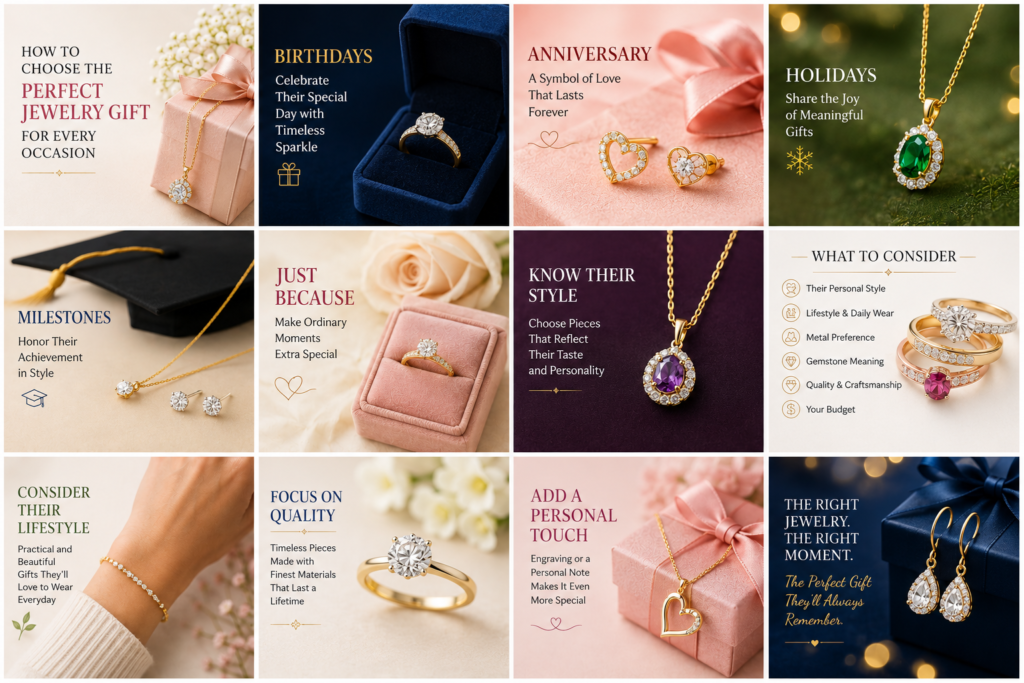
Before browsing a single collection, it helps to place the occasion on a spectrum from “everyday affection” to “milestone commitment.” The type, quality, and price point of the piece should track with where the occasion falls.
Engagements and Proposals
This is the highest-stakes jewelry purchase most people will ever make, and it’s worth treating it that way. Ring size, metal preference, and stone shape matter enormously, and unlike almost any other jewelry gift, guesswork is risky here. Many couples now shop together or use a wish list specifically to avoid a mismatch on a piece that will be worn daily for decades.
Weddings and Wedding Bands
The wedding band carries a different weight than the engagement ring. It’s simpler, meant to be worn alongside another piece, and built for a lifetime of daily contact: dishwashing, gym workouts, everything. That makes durability as important as design. Diamond wedding bands have become a popular middle ground between a plain metal band and a full eternity ring: they add brilliance without competing with the engagement ring, and modern settings like bezel and channel styles hold up far better to daily wear than delicate pave work.
For couples who want the option to stack bands over the years (a growing trend for anniversaries), a slim, low-profile diamond band leaves room to add more later without the stack looking bulky.
Anniversaries
Anniversary jewelry tends to follow milestone logic: smaller, symbolic pieces for early years, more significant pieces at five, ten, twenty-five. Eternity bands, upgraded stone settings, and birthstone pieces tied to the wedding date are all common choices. If the recipient already wears a wedding band, a piece that complements rather than competes with it (a matching metal tone, a slimmer profile) tends to get worn more.
Birthdays
Birthdays give the most creative freedom of any occasion on this list. Birthstone jewelry remains a reliable choice because it’s personal without being presumptuous, but the more effective approach is simply paying attention to what the recipient already wears. Someone who lives in delicate gold layers won’t reach for a bold silver cuff, no matter how nice it is.
Anniversaries at Work: Promotions and Retirements
Corporate and milestone-career gifting has shifted toward jewelry as a more personal alternative to generic plaques or gift cards. The key here is restraint: understated pieces (a simple pendant, cufflinks, a classic bracelet) read as thoughtful, while anything flashy can feel awkward in a professional context.
New Baby and Push Presents
This category has grown significantly as a recognized occasion in its own right. Birthstone pieces representing the new child, eternity-style bands, or personalized pendants with initials or a birth date are the most common and best-received choices.
Valentine’s Day, Mother’s Day, and “Just Because”
These lower-stakes occasions are where a lot of people overspend to compensate for not knowing what to buy. Resist that instinct. A well-chosen, moderately priced piece (stud earrings, a simple pendant, a stackable ring) that matches the recipient’s actual style will be worn far more than an expensive piece that doesn’t.
Know the Recipient Before You Know the Piece
Every guide to jewelry gifting eventually arrives at the same core advice, because it’s the advice that actually works: look at what the person already wears. Their existing jewelry tells you almost everything you need to know.
- Metal tone: Check whether they consistently wear gold, white gold/platinum, or silver-toned pieces. Mixing metals intentionally is a current trend, but it’s a style choice, so don’t assume it unless you’ve seen them do it.
- Scale and boldness: Do they wear delicate, minimal pieces or larger statement jewelry? This matters more than the specific item type.
- Existing collection: Would this piece have to compete with something they already own and love, or complement it?
- Lifestyle: Someone who works with their hands, plays sports, or has an active job needs jewelry that can handle daily wear: secure settings, durable metals, low-snag designs.
- Ears, if buying earrings: Confirm piercings and preferred backings (screw-back, push-back, hoops vs. studs) before buying.
The Practical Checklist Before You Buy
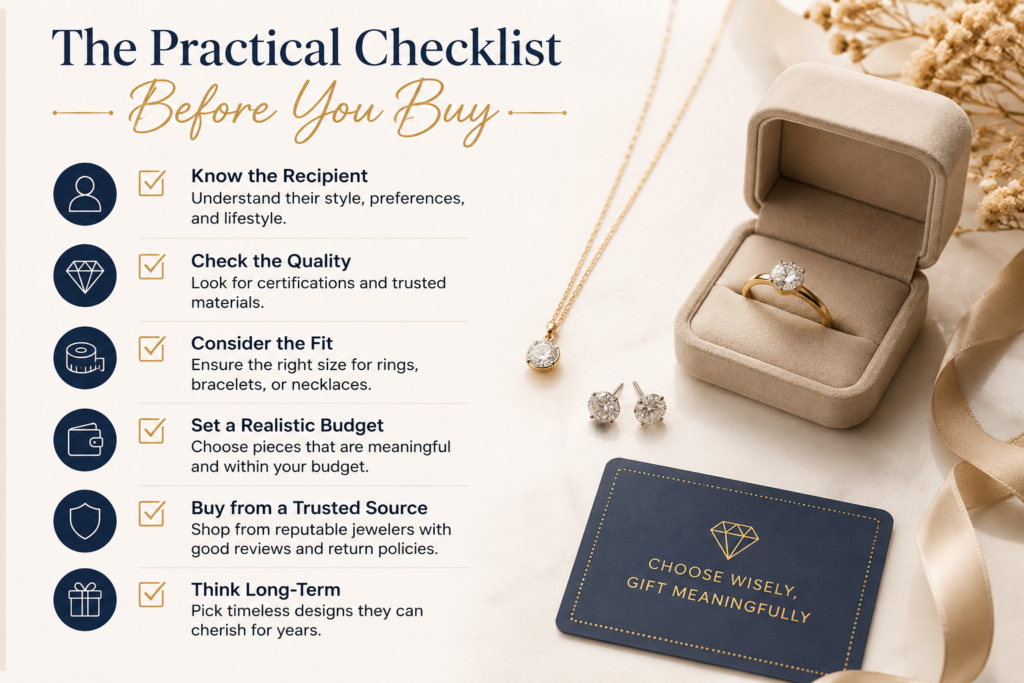
Once you know the occasion and the recipient, a few practical questions separate a gift that gets worn from one that gets returned.
1. Metal
14K and 18K gold (yellow, white, or rose), platinum, and sterling silver are the standard options. Platinum and 14K gold hold up best to daily wear; softer, higher-karat golds (22K, 24K) scratch more easily and suit occasional-wear pieces better than everyday ones.
2. Stone Quality and Type
If the piece includes a diamond, ask about the 4Cs (cut, color, clarity, and carat) and whether it’s natural or lab-grown. Lab-grown diamonds are chemically, physically, and optically identical to mined diamonds, typically cost 30 to 50% less at the same size and quality, and come with the same certification (IGI, GIA) from reputable retailers. For pieces meant for daily wear, like diamond wedding bands, that price difference often means the buyer can choose a larger stone or a more secure setting for the same budget.
3. Sizing
Rings are the one category where sizing mistakes are common and frustrating to fix. If you don’t know the recipient’s ring size, borrow a ring they already wear on the relevant finger and have it measured, or choose a style with resizing flexibility. Necklace and bracelet lengths are more forgiving but still worth confirming for anyone with a strong preference for choker-length versus longer chains.
4. Budget
Budget should follow occasion significance, not the other way around. It’s reasonable to spend more on an anniversary or wedding-related piece than on a birthday gift, and there’s no rule requiring a specific number of months’ salary. That guidance is a marketing invention, not a financial standard. Meaningful, well-made pieces exist at every price point.
5. Durability and Care
Ask how the piece holds up to daily wear: is the setting secure, is the plating likely to wear off, does the metal tarnish? A piece intended for occasional wear (statement earrings, an evening necklace) can prioritize design over durability. A piece intended for daily wear, wedding bands especially, should prioritize durability first.
6. Certification and Return Policy
For any diamond or gemstone purchase above a modest price point, confirm there’s an independent certificate (GIA or IGI for diamonds) and a reasonable return or resizing policy. Reputable retailers offer both without hesitation.
A Closer Look: Choosing a Diamond Wedding Band
Because wedding bands sit at the intersection of the most emotionally significant occasion and the most demanding daily-wear requirements, they deserve their own checklist. When browsing diamond wedding bands, consider:
- Profile height: Lower-profile settings snag less on clothing and gloves and suit active lifestyles.
- Setting security: Bezel and channel settings enclose the diamond in metal and are generally more secure for daily wear than open prong settings.
- Pairing with the engagement ring: Curved or contoured bands are designed to nest against a specific engagement ring shape; straight bands offer more flexibility if the pairing might change.
- Metal match: Matching metal tone to the engagement ring is traditional, but mixed-metal stacking is now a well-established and accepted style choice.
- Eternity vs. half-eternity: Full eternity bands have diamonds around the entire band (better for even wear but harder to resize); half-eternity bands have diamonds only on the top half (easier to resize, slightly lower cost).
Presentation and Timing
The piece itself does most of the work, but presentation and timing shape how it lands. Reputable jewelers provide branded boxes and, for engagement or wedding purchases, often insured shipping, both worth confirming before you buy.
For milestone occasions, give the piece at a moment with some privacy and attention rather than folding it into a busy family gathering; jewelry gifts tend to be more meaningful when the recipient has a moment to actually look at what they’ve been given.
Common Mistakes to Avoid
- Buying based on trend rather than the recipient’s actual style.
- Guessing ring size instead of confirming it, for anything other than a low-stakes gift.
- Assuming a bigger stone or higher price automatically means a better gift.
- Skipping certification on diamond or gemstone purchases.
- Choosing a delicate, high-maintenance piece for someone with an active, hands-on lifestyle.
- Overspending on a low-stakes occasion to compensate for not knowing what to buy.
Quick Decision Framework
When in doubt, work through these four questions in order:
- What does the occasion actually call for: a milestone piece or an everyday gesture?
- What does the recipient already wear, and what would complement it?
- Will this piece be worn daily, occasionally, or for a single event, and does its durability match?
- Does the retailer offer certification, sizing support, and a fair return policy?
Final Thoughts
The perfect jewelry gift isn’t the most expensive piece in the case; it’s the one that matches the occasion’s significance and the recipient’s lifestyle so well that they reach for it without thinking. This holds true for everything from a $60 pair of studs on a random Tuesday to a wedding band meant for a lifetime of wear.
Whatever the occasion, start with the recipient, verify the practical details, and choose accordingly. For couples looking for their perfect piece, Lunéa Paris offers certified lab-grown diamond wedding bands featuring durable, daily-wear settings.
Whatever the occasion, start with the person, confirm the practical details, and let the piece follow from there. For couples working through that last category, browsing Lunéa Paris’s diamond wedding bands is a reasonable place to start. Lab-grown stones, certified quality, and a range of settings built for daily wear.