Galgotias University has been directed to vacate its stall at the India AI Impact Summit in New Delhi following a controversy over a Chinese-made robotic dog that was allegedly presented as an indigenous innovation, government sources confirmed on Wednesday.
The Greater Noida-based institution faced swift action after a video from the high-profile summit went viral on social media, sparking widespread criticism about how the technology was described at the event.
Key Takeaways
- Galgotias University displayed a Chinese-made Unitree Go2 robotic dog at the India AI Impact Summit
- A viral video showed the robot being presented as “Orion” with language suggesting in-house development
- The university has been asked to vacate the expo stall following widespread criticism
- University officials claim the robot was only meant as an educational tool and that claims of indigenous development were misinterpreted
- The controversy has raised questions about transparency and vetting at high-profile government AI events
What Happened at the AI Summit?
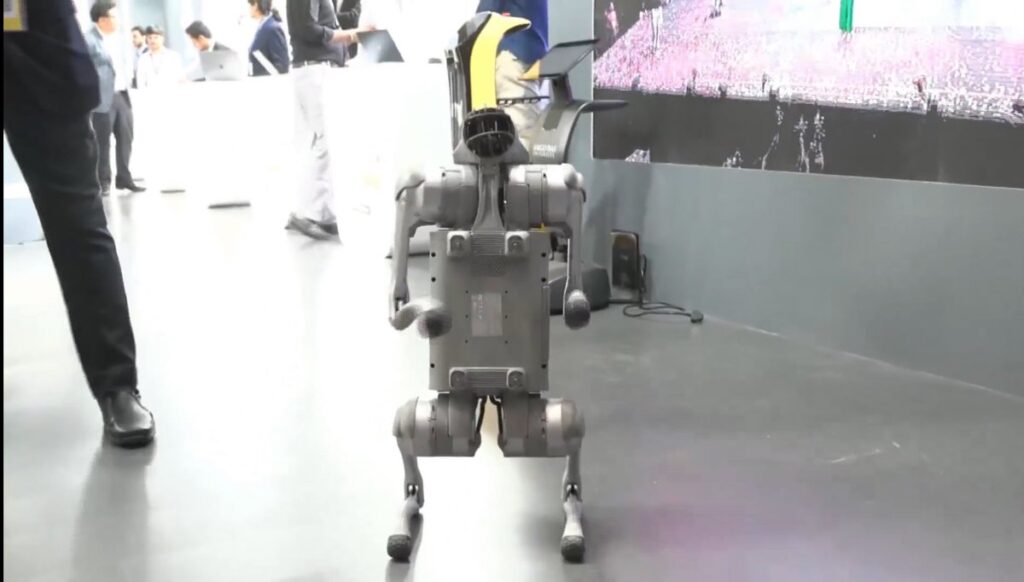
The controversy began when a video surfaced showing a Galgotias University representative presenting a robotic dog named “Orion” at the India AI Impact Summit 2026, which is being held at Bharat Mandapam in New Delhi from February 17-21.
In the now-deleted DD India video, Professor Neha Singh was seen describing the robot’s features during a media interaction. The presentation gave viewers the impression that the robotic dog was developed by the university’s Centre of Excellence as part of their reported Rs 350 crore AI ecosystem initiative.
Social media users quickly identified the device as the Unitree Go2, a commercially available quadruped robot manufactured by Chinese robotics company Unitree Robotics. The product is sold online in India for approximately Rs 2 to 3 lakh.
The Viral Backlash
The video triggered immediate backlash online, with critics accusing the university of rebranding an imported Chinese product as an Indian breakthrough. Users questioned how the device was vetted and presented at a summit designed to showcase India’s AI capabilities on a global stage.
An X (formerly Twitter) community note fact-checked the university’s later statements, calling them “incorrect and misleading” and stating that the university had “named the robot ‘Orion’ and explicitly claimed it was developed by their team.”
The controversy gained additional traction when users pointed out that another device at the stall — a drone — appeared to match the Striker V3 ARF soccer drone manufactured by Skyball and available for around $453.
University’s Response and Clarification
In response to the growing backlash, Galgotias University issued multiple statements defending its actions.
In an official press release, the university stated: “We at Galgotias, faculty and students, are deeply pained by the propaganda campaign against our university. We would like to clearly state that the robotic programming is part of our endeavour to make students learn AI programming and develop & deploy real world skills using globally available tools and resources.”
The university added: “Let us be clear: Galgotias has not built this robodog, nor have we ever claimed to.”
The institution described the Unitree robot as a learning tool for students and insisted that it never intended to present it as an indigenous development. The university emphasized that “innovation knows no borders” and that students must be exposed to cutting-edge global technology.
Faculty Members Defend Actions
Professor Neha Singh, who appeared in the viral video, told ANI that the controversy stemmed from a “misinterpretation.”
“We have never claimed that it is ours, Indian, or Galgotian. Its main branding is still on it. The robot that had come for a particular task has gone there for the children’s study, for the children’s research and development,” Singh said.
She clarified that she is a communications faculty member at the School of Management and does not teach AI. “By one misinterpretation, the internet has gone by storm. It might be that I could not convey well what I wanted to say, or it was misunderstood,” she added.
When asked about reports that the university was asked to vacate the expo, Singh stated: “Only you (the media) have heard what the government has said. As far as I know, we are here at the expo. As a university, we are standing tall. The robot was brought here only for projection.”
Professor Dr. Aishwarya Shrivastava also defended the university, stating: “We never claimed that we manufactured it (robodog), it was only a part of our AI investment. It got misinterpreted in a big way.”
The Core Issue: Presentation vs. Procurement
While universities commonly procure global technologies for educational purposes, the central issue in this controversy is not about importing hardware for learning but about how the products were presented at a global platform.
Critics argue that the presentation at the summit projected the robotic dog not merely as a purchased educational tool, but as part of the university’s own development ecosystem. The university’s own press release, which highlighted a “comprehensive Rs. 350+ crore Artificial Intelligence ecosystem,” added to the perception that these were in-house innovations.
The deleted DD India video and the initial presentation language created confusion about whether the university was showcasing student learning tools or claiming to have developed advanced AI technologies indigenously.
Context: India AI Impact Summit 2026
The India AI Impact Summit is a five-day flagship event built around three core pillars: People, Planet, and Progress. It has attracted over 20 heads of state, 60 ministers, and 500 global AI leaders, making it the first major global AI gathering hosted in the Global South.
Prime Minister Narendra Modi inaugurated the India AI Impact Expo 2026 at Bharat Mandapam on Monday, emphasizing that India’s progress in AI would contribute to both national transformation and global advancement.
The summit is positioned as a critical platform to showcase India’s AI ambitions under the IndiaAI Mission and Digital India initiative. The timing and visibility of the controversy have raised concerns about credibility and vetting processes at such high-profile events.
Political Response
The controversy also drew political attention. Congress leader Rahul Gandhi called the incident a “disorganised PR spectacle” at the AI Impact Summit, though he did not elaborate further on his comments.
The India AI Impact Summit continues through February 21, with Prime Minister Modi scheduled to deliver the inaugural address on February 19.
Also read:
- iOS 26.4 Beta 1 Adds More Color to Apple Music App UI
- T-Mobile Launches Real Time Call Translation for Any Phone