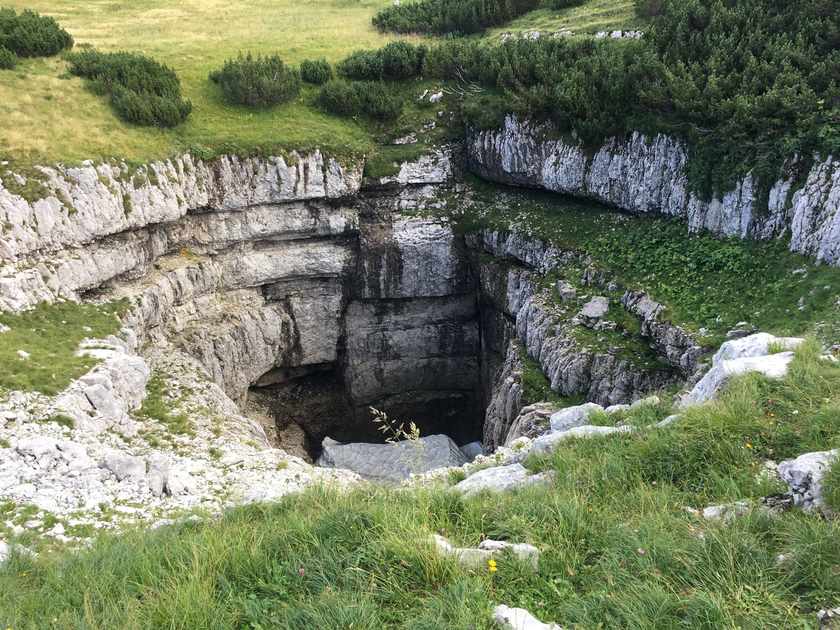
Homeowners in the Hideaway Hills subdivision of Black Hawk, South Dakota, have definitively lost their legal challenge against the State of South Dakota following a unanimous ruling by the South Dakota Supreme Court. The high court’s decision, issued on Thursday, July 10, 2026, upheld a lower court’s finding that the state is protected by sovereign immunity, thereby precluding the homeowners’ 60 million USD class-action lawsuit.
This ruling concludes a protracted legal battle for approximately 150 property owners whose homes were severely impacted by a large sinkhole that emerged in April 2020. A dozen homes in the community, located just west of Rapid City, were condemned and remain vacant due to the instability caused by the geological event.
The Hideaway Hills Sinkhole and the Class-Action Lawsuit
The catastrophic sinkhole, which opened above a former underground gypsum mine, led to significant property damage and forced residents from their homes. In response, a group of affected property owners, joined by other homeowners in the Hideaway Hills subdivision, initiated a class-action lawsuit against the State of South Dakota.
A class-action lawsuit is a legal proceeding where one or more plaintiffs sue on behalf of a larger group of people who have similar claims. In this case, the plaintiffs, represented by the national law firm Fox Rothschild, sought 60 million USD in damages, arguing the state was liable for the structural failures.
The lawsuit, formally known as Morse V. State, was filed in July 2024. The homeowners contended that the state’s historical mining operations and subsequent land management were directly responsible for the sinkhole’s formation. Such complex litigation often involves extensive discovery and expert testimony, as seen in other significant legal challenges like those involving county map challenges citing new voting regulations.
Historical Mining Operations and Land Development
The origins of the dispute trace back to the early 1900s when a company named Dakota Plaster began digging underground mine shafts in the area to extract gypsum, a mineral used to slow the hardening of concrete. The State of South Dakota subsequently opened its own concrete plant in Rapid City in 1925 and commenced gypsum mining, including on the land that would later become the Hideaway Hills subdivision.
State lawyers maintained that their mining activities were exclusively surface-level, asserting that no underground mining was conducted by the state, although blasting did occur. This distinction was central to the state’s defense against liability claims.
In the 1990s, the state ceased its mining operations on the site, reclaimed the land for grazing purposes, and sold it to a private owner in 1994. This owner resided and ranched on the property before selling it to a developer in the early 2000s, who then obtained permission from Meade County to construct the Hideaway Hills subdivision.
A key point of contention was the state’s retention of underground mineral rights after the 1994 sale. The homeowners argued that this retention implied ongoing responsibility for the subsurface integrity of the land, a position that the Supreme Court ultimately rejected.
Legal Arguments and the Doctrine of Sovereign Immunity
The homeowners’ primary argument centered on the assertion that the state had improperly reclaimed the mining site, allegedly filling mined areas with overly soft materials that eroded over time, leading to the sinkhole. They characterized the state’s failure to properly close its mining operation as akin to an inverse condemnation.
Inverse condemnation is a legal action brought by a property owner against a government entity that has taken or damaged their property without formal eminent domain proceedings. Eminent domain is the government’s power to take private property for public use, provided just compensation is paid. The homeowners argued that the state’s actions effectively constituted a taking of their land without compensation.
Conversely, the state’s legal team contended that any underground mining that contributed to the sinkhole was conducted by the prior private owner, not the state. They also asserted that the developer was aware of the underground mine’s existence before constructing the homes but failed to inform prospective homeowners. This type of complex legal defense often requires meticulous review of historical records and property deeds, similar to the detailed work involved when attorneys request a new trial for Lasley.
A circuit court judge initially ruled in favor of the state in September 2024, citing sovereign immunity. Sovereign immunity is a legal doctrine that protects government entities from being sued without their consent. This principle is deeply rooted in common law and often enshrined in state constitutions, limiting the avenues for citizens to pursue legal remedies against the state.

Trust Post Desk
A journalist and editor at TrustPost.org covering world and national news, technology updates and human-interest stories. They check every fact, interview sources in person or online, and aim to deliver clear, accurate reporting. Their work ranges from breaking news to in-depth features and daily newsletters. Outside the newsroom, they follow emerging trends and engage with readers on social media.