Researchers at the Massachusetts Institute of Technology unveiled an ultrasound wristband system on June 9, 2026, that translates human hand gestures into training data for robotic systems by capturing muscle, tendon, and ligament movements beneath the skin. The device uses high-frequency sound waves to visualize internal hand mechanics and transmit this information to a computer, which then uses artificial intelligence to enable robotic hands to replicate the gestures with remarkable precision.
In This Article
- MIT’s Ultrasound Wristband Captures Muscle Movements for Robotics Training
- Achieving Human-Like Dexterity: The Challenge for Humanoid Robots
- Real-Time Gesture Recognition: How the System Mimics Human Actions
- Future Applications of AI-Driven Gesture Recognition in Robotics
- Frequently Asked Questions
- Conclusion
The technology addresses a critical challenge in robotics: teaching machines to perform tasks requiring fine motor control, from grasping delicate objects to executing complex manipulation sequences. Laboratory testing with eight volunteers demonstrated that the system could mirror all 26 letters of American Sign Language within 120 milliseconds, opening pathways for applications in household assistance, surgical procedures, and other scenarios demanding human-like dexterity.
MIT’s Ultrasound Wristband Captures Muscle Movements for Robotics Training
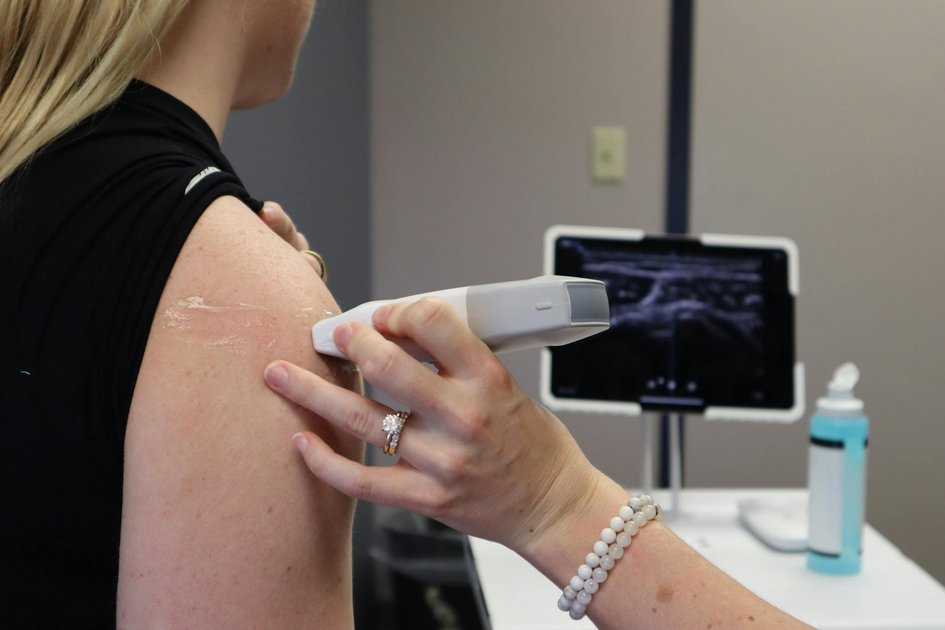
The wristband operates by emitting high-frequency sound waves that penetrate the wearer’s skin to create real-time images of muscle and tendon activity. This ultrasound imaging technique allows the device to see beneath the surface layer and track the internal biomechanics that produce hand movements, according to reporting from the Associated Press.
These images travel wirelessly to a computer system equipped with machine learning algorithms trained to decode the ultrasound data into what engineers call degrees of freedom. The human hand possesses 22 distinct degrees of freedom, representing specific ways joints can bend or rotate.
Xuanhe Zhao, an MIT professor of mechanical engineering who led the development team, explained that the collected data can train robots to perform household tasks with the same dexterous hand motion humans naturally employ.
The wireless capability means the controlling person and the receiving robot need not occupy the same physical space, enabling remote operation scenarios where a human operator could guide a robot performing tasks in hazardous environments or distant locations.
Achieving Human-Like Dexterity: The Challenge for Humanoid Robots
Humanoid robots have struggled with seemingly simple tasks like grasping a cup or manipulating small objects, challenges that arise from the complexity of replicating human hand mechanics. Previous motion capture systems faced significant obstacles when attempting to track even a fraction of the 22 degrees of freedom present in human hands.
Traditional approaches relied on external cameras, gloves with embedded sensors, or vision-based tracking, each carrying limitations in accuracy, latency, or the ability to capture the full range of hand movements. Camera systems often fail when fingers occlude each other, while sensor gloves can restrict natural movement and prove cumbersome for extended use.
The MIT ultrasound approach bypasses these constraints by monitoring the source of movement directly: the muscles and tendons that drive hand motion. This internal perspective provides data unavailable to external observation systems.
The research addresses a growing need as the artificial intelligence industry expands beyond computer-based tasks into physical world applications. While much of the technology sector remains focused on AI assistants handling digital workflows, scientists like Zhao work to equip AI systems with sensory data from physical environments, enabling robots to interact meaningfully with objects and spaces.
Real-Time Gesture Recognition: How the System Mimics Human Actions
The AI algorithm powering the system analyzes ultrasound images in real time, translating them into control signals that direct robotic hand movements. The 120-millisecond response time demonstrated in laboratory tests represents near-instantaneous replication, creating a fluid mirroring effect that closely approximates natural human gesturing.
During demonstrations, eight volunteers performed a range of hand gestures while wearing the wristband, including the complete American Sign Language alphabet. The robotic hand successfully reproduced each gesture with precision, validating the system’s ability to capture subtle variations in hand positioning and finger articulation.
This performance marks a substantial improvement over earlier robotic control interfaces, which often exhibited noticeable lag or failed to capture the nuanced movements required for complex tasks. The speed and accuracy achieved by the MIT team suggest the technology has matured beyond proof-of-concept stage toward practical implementation.
The system’s architecture separates data capture from processing, allowing the ultrasound wristband to remain lightweight and unobtrusive while offloading computational demands to separate computer hardware. This design choice prioritizes wearer comfort and extended use scenarios, critical factors for applications requiring sustained operation.
Future Applications of AI-Driven Gesture Recognition in Robotics
Beyond immediate teleoperation applications, the MIT research team envisions the wristband serving as a tool for building comprehensive datasets of human hand motion. These datasets could train autonomous robotic systems to perform dexterous tasks without requiring continuous human guidance, a capability that would represent a significant advancement in robot learning.
Current machine learning approaches for robotics often struggle with limited training data, particularly for complex manipulation tasks. By enabling easy collection of high-quality motion data from multiple users performing various tasks, the wristband could accelerate the development of robots capable of generalizing from examples to novel situations.
Surgical applications present particularly promising opportunities, where the technology could either train surgical robots to replicate expert techniques or enable remote surgery with enhanced precision. The medical field has long sought ways to protect critical data while improving procedural outcomes through robotic assistance, and this gesture recognition system could advance both objectives.
Household robotics represents another target domain, with potential applications ranging from meal preparation to cleaning tasks requiring delicate object handling. Zhao specifically highlighted housework as a use case where the dexterous hand motion data collected by the system could enable robots to execute tasks currently reserved for human workers.
The technology also intersects with broader developments in AI-powered robotic systems that aim to bring autonomous assistance into everyday environments. As humanoid robots advance toward practical deployment in homes and workplaces, motion capture systems that accurately translate human skill into machine-executable instructions become increasingly valuable.
Manufacturing and assembly operations could benefit from robots trained using this approach, particularly for tasks involving small components or requiring adaptive responses to varying conditions. Industries seeking to automate complex manual processes while maintaining quality standards may find ultrasound-based gesture training a viable solution.
The research emerges as concerns about AI governance challenges intensify across industries deploying artificial intelligence systems. Transparent, human-supervised training methodologies like the MIT wristband approach may help address accountability concerns by maintaining clear connections between human expertise and robot behavior.
Educational and rehabilitation applications also appear feasible, where the system could help individuals learn proper hand techniques for various skills or assist in physical therapy by providing objective feedback on movement patterns and progress over time.
The wireless operation capability opens possibilities for hazardous environment work, allowing human operators to guide robots through dangerous scenarios from safe locations. Search and rescue operations, nuclear facility maintenance, and deep-sea exploration represent domains where remote dexterous manipulation could prove invaluable.
As the technology matures, integration with other AI tools that boost workflow efficiency could create comprehensive robotic systems capable of handling complex multi-step processes with minimal human intervention. The gesture capture system provides the fine motor control component that complements higher-level AI planning and decision-making capabilities.
Frequently Asked Questions
How does the ultrasound wristband work in capturing hand movements?
The wristband emits high-frequency sound waves that penetrate the skin to create real-time images of muscle, tendon, and ligament movements inside the hand and forearm. These ultrasound images are transmitted wirelessly to a computer system that uses AI algorithms to decode the internal biomechanics into specific joint movements, tracking up to 22 degrees of freedom. The system then translates this data into control signals that enable a robotic hand to replicate the gestures with a response time of 120 milliseconds.
What are the specific tasks that humanoid robots can learn using this technology?
Robots can learn dexterous tasks requiring fine motor control, including household activities like grasping cups and other delicate objects, performing cleaning tasks, and executing meal preparation steps. The system has demonstrated the ability to train robots to replicate all 26 letters of American Sign Language, indicating its capacity to handle complex finger articulation. Beyond domestic applications, the technology shows promise for surgical assistance, manufacturing assembly operations involving small components, and any scenario requiring precise hand manipulation that previously exceeded robotic capabilities.
How does this advancement compare to previous methods of training robots?
Earlier systems relied on external cameras, sensor-equipped gloves, or vision-based tracking, each facing limitations in accuracy, latency, or ability to capture occluded movements when fingers blocked each other from view. These approaches often struggled to track even a fraction of the 22 degrees of freedom in human hands and typically exhibited noticeable lag between human action and robot response. The MIT ultrasound approach monitors muscles and tendons directly at their source, providing internal data unavailable to external observation systems and achieving near-instantaneous replication at 120 milliseconds, representing a substantial improvement in both precision and speed over predecessor technologies.
Conclusion
The ultrasound wristband system developed at MIT represents a measurable advance in bridging the gap between human dexterity and robotic capability. By capturing internal biomechanics rather than relying on external observation, the technology overcomes fundamental limitations that have constrained previous motion capture approaches.
The 120-millisecond response time and successful replication of complex gestures including the complete American Sign Language alphabet demonstrate technical maturity beyond laboratory curiosity. With applications spanning household assistance, surgical procedures, manufacturing, and hazardous environment operations, the system addresses real needs across multiple industries seeking to automate tasks requiring fine motor control.
The path toward building comprehensive motion datasets promises to accelerate autonomous robot learning, potentially enabling machines to generalize from human demonstrations to independent task execution. As the technology transitions from research to practical deployment, it may fundamentally reshape how robots acquire the dexterous manipulation skills that have long distinguished human workers from automated systems.

Trust Post Desk
A journalist and editor at TrustPost.org covering world and national news, technology updates and human-interest stories. They check every fact, interview sources in person or online, and aim to deliver clear, accurate reporting. Their work ranges from breaking news to in-depth features and daily newsletters. Outside the newsroom, they follow emerging trends and engage with readers on social media.