If you’ve ever opened Twitter, scrolled through TikTok, or read a comment section on Instagram and felt like you were decoding a foreign language
— you’re not alone. Social media moves fast, and the shorthand that comes with it moves even faster.
For more context, see our coverage of Social Media Trends 2026.
From OG classics like LOL and BRB to newer additions like NPC, IYKYK, and IJBOL, the digital lexicon has exploded into hundreds of abbreviations
that vary by platform, age group, and even subculture.
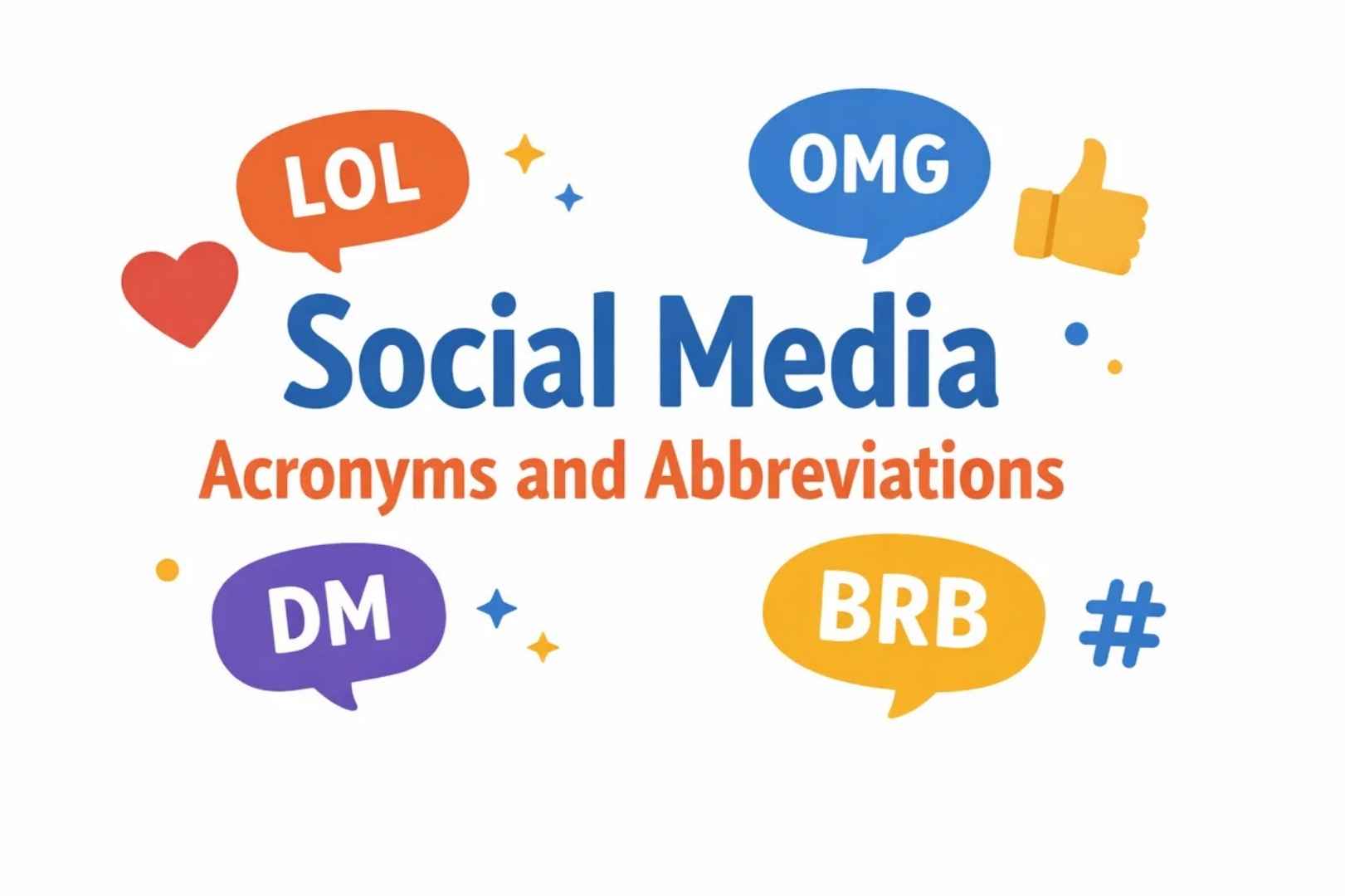
This guide covers every major social media acronym and abbreviation you need to know in 2026 — organized by category, explained clearly, and written so you’ll actually remember them.
For more context, see our coverage of Cryptocurrency Market Update 2026.
Before diving into the list, it helps to understand why internet shorthand exists in the first place.
It started with character limits — early SMS messages capped at 160 characters, and Twitter launched with a 140-character ceiling.
Typing out “laughing out loud” cost precious space. Abbreviating it to LOL solved the problem instantly.
For more context, see our coverage of Climate Litigation 2026 Courts Around the World.
Why Social Media Abbreviations Exist
But character limits aren’t the whole story. Acronyms also create in-group identity. When you use the right shorthand, you signal that you belong —
that you’re fluent in the culture of a platform. IYKYK (If You Know You Know) is itself a perfect example. It’s exclusionary by design.
That’s the point.
Today, even platforms with generous character limits — Reddit’s multi-thousand-word posts, Facebook’s near-unlimited updates — are flooded with abbreviations because the habit is now cultural, not just functional.
These are the abbreviations that started it all. Most were born in AOL chat rooms and SMS messages in the late 1990s and early 2000s, and they haven’t gone anywhere.
The Classic Acronyms — The OGs Everyone Knows
LOL — Laughing Out Loud. The undisputed king of internet abbreviations. Worth noting: in 2026, LOL rarely means genuine laughter.
It’s softened into a filler that signals tone — a little like “haha” but lighter. “I missed my bus again lol” is not funny.
It’s resignation.
LMAO — Laughing My Ass Off. A step up from LOL in intensity. Paired frequently with ROFL (Rolling On the Floor Laughing) for extreme
comedic effect, giving you LMFAO — which briefly became a band name and permanently confused anyone’s parents who heard it.
BRB — Be Right Back. Signals a short absence from a conversation. Its counterpart, AFK (Away From Keyboard), signals a longer or indefinite absence.
GTG or G2G (Got To Go) signals the conversation is ending entirely.
Everyday Conversation Acronyms
OMG — Oh My God. Evolved into OMFG (Oh My F***ing God) for stronger emphasis. Now used so casually it’s nearly punctuation.
OML — Oh My Lord. Slightly softer than OMG, popular among younger Gen Z users.
OMS — Oh My Stars. An older, quainter exclamation that resurfaced ironically.
Reaction and Emotion Acronyms
IMO / IMHO — In My Opinion / In My Humble Opinion. The H in IMHO is frequently ironic — people often use it before extremely confident, not-at-all-humble statements.
TBH — To Be Honest. “TBH this movie is perfect” is just a recommendation. “TBH I don’t think you’re handling this well” is confrontation softened with a three-letter buffer.
IDK — I Don’t Know. Paired with IDC (I Don’t Care) and IDEK (I Don’t Even Know) for varying levels of cluelessness.
Compliment, Hype and Gen Z Culture Acronyms
IDGAF — I Don’t Give A F***. Complete indifference, stated emphatically. IDGAFF (I Don’t Give A Flying F***) takes it further.
NVM — Never Mind. Used to retract a question or thought, often passive-aggressively.
SMH — Shaking My Head. Expresses disappointment or disbelief. Spawned SMDH (Shaking My Damn Head), SMFH (Shaking My Fing Head), and even SMFHID (Shaking My Fing Head In Disbelief).
Platform-Specific Acronyms
FYI — For Your Information. Comes in passive-aggressive or genuinely helpful flavors depending entirely on context.
JK — Just Kidding. The original tone softener before “/s” and lol existed.
ASAP — As Soon As Possible. Migrated from corporate emails into casual social media with no loss of urgency.
Twitter / X
ATM — At The Moment. “Not really in the mood ATM.” Entirely different from the cash machine.
BTW — By The Way. One of the oldest transitional acronyms still in daily use.
FYI — For Your Information. Already listed but worth emphasizing its dual-use as informative and passive-aggressive.
TTYL — Talk To You Later. The BRB of goodbyes.
TTYS — Talk To You Soon. Slightly warmer and more specific than TTYL.
CYA — See Ya. Also doubles as “Cover Your A**” in professional contexts.
TikTok
L8R — Later. An SMS-era relic that refuses to die entirely.
GN / GM — Good Night / Good Morning. The daily bookmarks of parasocial online relationships.
HAND — Have A Nice Day. Sincerely or sarcastically deployed depending on the conversation.
HAK — Hugs And Kisses. An older version of xoxo.
WYWH — Wish You Were Here. Used under travel or event posts.
IMU — I Miss You. Common in close-friend DMs.
Twitch and Gaming Streams
MYOB — Mind Your Own Business. MYOFB takes it significantly further.
These are the abbreviations that fill everyday DMs, comment sections, and group chats.
DM — Direct Message. The universal term across platforms for private messaging. PM (Private Message) is older, mostly surviving on Reddit and older forums.
Gaming and Esports Acronyms
IRL — In Real Life. Used to distinguish physical-world events or relationships from online ones. “We’ve been friends online for years but never met IRL.”
TBT — Throwback Thursday. A social media posting tradition where users share old photos on Thursdays. FBF (Flashback Friday) is the Friday variant.
OOTD — Outfit Of The Day. Huge on Instagram and TikTok, particularly in fashion communities. Spawned GRWM (Get Ready With Me), a content format
where creators film their full preparation routine.
Relationship and Dating Acronyms
FOMO — Fear Of Missing Out. Describes the anxiety of feeling excluded from experiences others are having. Its calmer counterpart, JOMO (Joy Of Missing Out), describes contentment with staying in.
IKR — I Know Right. Agreement and validation in three letters.
NGL — Not Gonna Lie. A honesty disclaimer that softens what follows. “NGL, that was impressive.”
Mental Health and Wellness Acronyms
TIL — Today I Learned. Massive on Reddit, used to introduce a surprising fact.
ELI5 — Explain Like I’m 5. A request for a simple, jargon-free explanation of a complex topic.
TL;DR — Too Long; Didn’t Read. Used before a brief summary of a long post. The most useful acronym on the internet for busy people.
Political and Social Acronyms
AMA — Ask Me Anything. An open Q&A invitation, popularized by Reddit’s AMA threads.
OC — Original Content. Signals that the creator made the content themselves.
OP — Original Poster. Refers to the person who started a thread or post.
Food, Fitness and Lifestyle Acronyms
ITT — In This Thread. Used to describe what’s happening in a comment section. “ITT: people who’ve never cooked pasta arguing about cooking pasta.”
JW — Just Wondering. A low-pressure way to ask something potentially nosy.
OFC — Of Course. Quick affirmation in a DM chain.
Book, Fan and Hobby Acronyms
WDYM — What Do You Mean. Used to seek clarification, often with a hint of challenge.
WDYT — What Do You Think. An invitation for an opinion.
HYD — How Ya Doing. A casual check-in.
Business, Marketing and Creator Acronyms
WYD — What You Doing. The modern “are you free?” opener.
WYA — Where You At. Checking someone’s physical location.
WYO — What You On. Asking what someone is up to or what their plans are.
Tech and Internet Culture Acronyms
ICYMI — In Case You Missed It. Used to resurface old content or announcements.
LMK — Let Me Know. A soft request for information or an answer.
HMU — Hit Me Up. An invitation to contact someone.
International and Cross-Cultural Internet Shorthand
HMB — Hit Me Back. Used to request a reply.
ISTG — I Swear To God. Used for emphasis or frustration.
IIRC — If I Recall Correctly. A hedge before sharing something you’re not 100% sure about.
The Complete Master Reference Table
AFAIK — As Far As I Know. Signals the information might be incomplete.
AFAICT — As Far As I Can Tell. A slightly more qualified version of AFAIK.
YMMV — Your Mileage May Vary. Acknowledges that experiences differ.
FAQs
TBF — To Be Fair. Used to add balance to a one-sided argument.
FWIW — For What It’s Worth. Offers an opinion without claiming it’s definitive.
WTF — What The F***. Universal expression of shock, confusion, or outrage.
Final Thoughts
WTH — What The Heck. The cleaned-up version safe for all audiences.
WTActualF — What The Actual F***. Used when WTF alone isn’t emphatic enough.
FFS — For F***’s Sake. Expresses exasperation.
FML — F*** My Life. Self-deprecating frustration, usually over minor inconveniences.
CTFU — Cracking The F*** Up. Genuine hard laughter.
IJBOL — I Just Burst Out Laughing. A newer, more specific replacement for LOL when something is genuinely funny.
DED / DEAD — Used to mean “I’m laughing so hard I died.” “That video had me dead.”
ICANT — I Can’t (Even). Expression of being overwhelmed by emotion or humor.
IDFK — I Don’t F***ing Know. Frustrated version of IDEK.
KEKW — A Twitch emote representing loud laughter, now used in text.
Kek — Internet laughter, particularly in gaming communities. A variant of LOL.
HHH — Korean internet laughter equivalent. Three H’s is polite chuckling; dozens of H’s is losing it.
555 — Thai internet laughter. The number 5 in Thai is pronounced “ha,” so 555 = hahaha.
jejeje — Spanish internet laughter, particularly in Latin American communities.
These emerged largely from stan culture, Black Twitter, and Gen Z communities.
GOAT — Greatest Of All Time. The ultimate compliment. Applies to athletes, musicians, foods, and increasingly anything the commenter likes.
OG — Original Gangster. Broadly means someone who was doing something before it was popular. “She’s the OG of bookstagram.”
MVP — Most Valuable Player. Borrowed from sports but applied anywhere. “My umbrella was the MVP today.”
IYKYK — If You Know You Know. Used to hint at shared insider knowledge without explaining it. Functions as a wink at the in-crowd.
W / L — Win / Loss. Internet shorthand for a good or bad outcome. “That outfit is a W.”
NPC — Non-Player Character. Originally a gaming term for AI-controlled background characters. Now used to describe someone acting robotically or lacking original thought.
POV — Point Of View. Exploded as a TikTok content format. “POV: you’re the last person at the office on Friday.”
CEO — In social media slang, means “the best at something.” “She’s the CEO of eyeliner looks.”
FR / FR FR — For Real. Used to express sincerity or agreement. Doubling it intensifies the emphasis.
No Cap — No lie, I’m being serious. Its opposite, Cap, means someone is lying or exaggerating.
LFG — Let’s F***ing Go. An expression of extreme excitement or motivation. Also used in gaming to mean “Looking For Group.”
Ratio — When a reply has more likes than the original post, suggesting the reply is more popular. Being “ratioed” is a social media loss.
Slay — Performing or looking exceptionally well. “She absolutely slayed that presentation.”
IGTFY — I’ll Google That For You. Used (often passive-aggressively) to suggest someone could have found an answer themselves.
Lowkey / Highkey — Lowkey means subtly or quietly. Highkey means obviously or intensely.
AKA — Also Known As. Used to reference aliases or alternate names.
RT — Retweet. Sharing someone else’s tweet to your followers.
QRT — Quote Retweet. Resharing a tweet with your own added commentary.
FF — Follow Friday. A tradition of recommending accounts worth following every Friday.
TW / CW — Trigger Warning / Content Warning. Used to alert followers that content may be sensitive.
OOMF — One Of My Followers. Used to subtly reference someone without naming them. “OOMF really needs to hear this.”
Ratio — Already covered but especially prominent in political Twitter threads.
AITA — Am I The A**hole? The title format of Reddit’s most popular judgment community.
NTA — Not The A**hole.
YTA — You’re The A**hole.
ESH — Everyone Sucks Here.
NAH — No A**holes Here. The four verdict options in AITA threads.
TIFU — Today I F***ed Up. The opening format for Reddit’s confession community.
DAE — Does Anyone Else. “DAE feel genuinely tired after doing nothing?”
CMV — Change My View. Used on r/changemyview to invite counterarguments.
TIL — Today I Learned. A staple of Reddit’s front page.
ELI5 — Explain Like I’m 5. Already covered — originated on Reddit.
AMA — Ask Me Anything. Born and perfected on Reddit.
FYP — For You Page. TikTok’s algorithm-curated home feed. Creators tag videos #FYP hoping the algorithm amplifies them.
DC — Dance Credit. Used in captions to credit the original creator of a dance. “DC: @username.”
ALT — Alternative. Used to describe niche aesthetics or subcultures.
POV — Already covered but lives primarily on TikTok as a content format.
GRWM — Get Ready With Me. A content format that became a genre.
LB — Like Back. A reciprocal agreement to like each other’s posts.
CB — Comment Back. Same concept, applied to comments.
SFS — Shoutout For Shoutout. A mutual promotion agreement between accounts.
S4S — Share For Share. Same as SFS.
MCM / WCW — Man Crush Monday / Woman Crush Wednesday. Posting traditions for shouting out someone you admire.
Poggers / Pog — Twitch emote and slang for excitement or something impressive.
Copium — A blend of “cope” and “opium.” Describes irrational hope a losing team or gamer clings to.
Sadge — Twitch emote meaning sadness or disappointment. Now used in plain text.
Monkas — A Twitch emote conveying anxiety or nervousness.
KEKW — Already listed. Twitch emote for loud laughter.
VOD — Video On Demand. Archived stream content available after the live broadcast ends.
Sub — Subscriber. On Twitch, a financial supporter. On YouTube, anyone who follows a channel.
GLHF — Good Luck Have Fun. A gaming greeting exchanged at the start of a match.
GG — Good Game. Said at the end of a match — sincere or sarcastic depending on context.
GG EZ — Good Game, Easy. A deliberately unsportsmanlike version implying the opponent was no challenge.
GGWP — Good Game Well Played. The respectful, full version.
RPG — Role Playing Game.
FPS — First Person Shooter.
MMO — Massively Multiplayer Online game.
MMORPG — Massively Multiplayer Online Role Playing Game.
BR — Battle Royale. The genre that produced Fortnite, PUBG, and Warzone.
PVP — Player Versus Player.
PVE — Player Versus Environment.
HP — Hit Points or Health Points.
XP / EXP — Experience Points. Used in gaming and metaphorically in life: “gained a lot of XP from that job.”
DLC — Downloadable Content. Paid or free additions to a game.
F2P — Free To Play.
P2W — Pay To Win. Criticism of games where spending money gives competitive advantages.
RNG — Random Number Generator. Used to describe luck-based outcomes. Expanded to general use: “my commute is pure RNG.”
AGG — Aggressive. Used in gaming commentary.
NPC — Already covered — originally and primarily a gaming term.
DTR — Define The Relationship. The conversation about what two people actually are to each other.
FWB — Friends With Benefits.
SO — Significant Other. Gender-neutral term for a partner.
BAE — Before Anyone Else. Used as an affectionate term for a partner or close friend.
TF — The F***? Used to express disbelief, especially in reaction to relationship red flags.
GF / BF — Girlfriend / Boyfriend.
HML — Hit My Line. An invitation to call or message someone directly.
Ghosting — Cutting off all contact without explanation. Spawned Caspering (friendly ghosting) and Orbiting (watching someone’s stories without engaging).
Situationship — Not an acronym, but a social media-born term for a relationship that isn’t quite defined.
IRL — Especially relevant in dating: meeting in person after connecting online.
These have grown significantly as mental health conversations moved online.
MH — Mental Health. Used as a hashtag and in conversation.
SA — Sexual Assault or Substance Abuse depending on context. Always used with a CW (Content Warning).
ED — Eating Disorder. Used sensitively in support communities.
OCD — Obsessive Compulsive Disorder. Frequently misused casually online — worth knowing the correct clinical meaning.
PTSD — Post-Traumatic Stress Disorder. Similarly misused colloquially.
ADHD — Attention Deficit Hyperactivity Disorder. Has an enormous community on TikTok with its own subculture.
ASD — Autism Spectrum Disorder. Large self-advocacy community on Twitter and Tumblr.
SH — Self Harm. Used in sensitive communities with appropriate warnings.
DBT — Dialectical Behaviour Therapy. Referenced frequently in mental health support communities.
CBT — Cognitive Behavioural Therapy.
HP — Hyper fixation. ADHD community shorthand for intense, consuming interest in a topic.
Doomscrolling — Compulsively scrolling through negative news. A social media-born term that has entered mainstream vocabulary.
POTUS — President Of The United States.
FLOTUS — First Lady Of The United States.
SCOTUS — Supreme Court Of The United States.
VPOTUS — Vice President Of The United States.
MoC — Member of Congress. Used in political activism posts.
ACAB — All Cops Are Bastards. A protest slogan that became a social media hashtag.
BLM — Black Lives Matter. Civil rights movement and hashtag.
LGBTQ+ — Lesbian, Gay, Bisexual, Transgender, Queer/Questioning, and more.
GNC — Gender Non-Conforming.
NB / Enby — Non-Binary. Enby is the phonetic spelling of NB.
TERF — Trans-Exclusionary Radical Feminist. A pejorative used in gender discourse online.
SJW — Social Justice Warrior. Used critically across the political spectrum.
MSM — Mainstream Media. A term used across the political spectrum with varying connotations.
TPTB — The Powers That Be. Refers to those in authority, often used conspiratorially.
TBP — The Big Picture. Used in political threads to zoom out from specific events.
WFPB — Whole Food Plant Based. A dietary approach popular in wellness communities.
HCLF — High Carb Low Fat. Another dietary shorthand.
IF — Intermittent Fasting. A hugely popular wellness hashtag.
KETO — Ketogenic (diet). Not a true acronym but universally abbreviated.
GF — Gluten Free. Also means Girlfriend — context-dependent always.
DF — Dairy Free.
V / VG — Vegan / Vegetarian.
PR — Personal Record. Used in fitness communities to celebrate a new best performance.
PB — Personal Best. Interchangeable with PR.
DNF — Did Not Finish. Used in running, cycling, and book communities for abandoned efforts.
TBR — To Be Read. A staple of BookTok and Bookstagram — the reading list that never gets shorter.
DNR — Did Not Read. Used in book communities for titles abandoned immediately.
ARC — Advance Reader Copy. A pre-publication book sent to reviewers. Coveted in BookTok culture.
WIP — Work In Progress. Used by artists, writers, and creators sharing unfinished projects.
OTP — One True Pairing. A fan’s favourite romantic ship between two characters.
Ship — Derived from “relationship.” To “ship” two characters is to want them together romantically.
AU — Alternate Universe. Used in fan fiction to describe stories set outside the original canon.
Canon — What is officially true in a story or franchise.
HC — Headcanon. A personal interpretation about a character not confirmed by official sources.
NSFW — Not Safe For Work. Content inappropriate for professional or public settings.
SFW — Safe For Work. The opposite — appropriate for all audiences
B2B — Business to Business. Marketing aimed at companies rather than individual consumers.
B2C — Business to Consumer. Marketing aimed at individual buyers.
ROI — Return on Investment. How much value a campaign generated versus what it cost.
CTA — Call To Action. The “click here,” “subscribe now,” or “swipe up” prompt in marketing content.
CTR — Click-Through Rate. The percentage of people who clicked a link after seeing it.
UGC — User-Generated Content. Content created by regular users rather than brands.
KPI — Key Performance Indicator. The metric a campaign is being measured against.
CPM — Cost Per Mille (per 1,000 impressions). A standard advertising metric.
CPC — Cost Per Click. How much an advertiser pays each time someone clicks their ad.
SERP — Search Engine Results Page. Where your content ranks when someone searches for a term.
SEO — Search Engine Optimization. Making content rank higher in search results.
SMM — Social Media Marketing. Managing and growing a brand presence across platforms.
KOL — Key Opinion Leader. A regional term (especially Asia-Pacific) for what Western markets call an influencer.
PPE — Page Post Engagement. A Facebook/Meta ad objective focused on maximizing likes, comments, and shares.
CR — Conversion Rate. The percentage of viewers who take a desired action.
AOV — Average Order Value. Used in e-commerce social media strategies.
LTV — Lifetime Value. How much a customer is worth over the full relationship.
SLA — Service Level Agreement. Appears in brand customer service social media contexts.
HTTP / HTTPS — HyperText Transfer Protocol (Secure). The foundation of every web address.
URL — Uniform Resource Locator. A web address.
API — Application Programming Interface. Appears in tech Twitter constantly during outages and developer discourse.
UI / UX — User Interface / User Experience. Frequently debated in product and design communities.
AI — Artificial Intelligence. Possibly the most-used tech abbreviation of 2024–2026.
ML — Machine Learning. AI’s more specific subset.
LLM — Large Language Model. The architecture behind AI chatbots — became mainstream vocabulary in 2023.
GPT — Generative Pre-trained Transformer. Now used generically to mean “AI chatbot” by many users.
AR / VR — Augmented Reality / Virtual Reality.
NFT — Non-Fungible Token. Had a cultural moment in 2021–2022 and is now largely a punchline online.
Web3 — The decentralized internet concept associated with blockchain.
IP — Intellectual Property. Used in fandom and business contexts alike.
TOS / ToS — Terms Of Service. Referenced when platforms change their rules and users revolt.
GDPR — General Data Protection Regulation. EU privacy law that appears in tech and marketing discussions.
DDoS — Distributed Denial of Service. A cyberattack — referenced when platforms go down unexpectedly.
VPN — Virtual Private Network. Referenced constantly in privacy discussions and streaming workarounds.
2FA / MFA — Two-Factor Authentication / Multi-Factor Authentication. Security best practices in tech communities.
OSS — Open Source Software. A community and philosophy as much as a development model.
PEBKAC — Problem Exists Between Keyboard And Chair. A tech community joke blaming user error.
Internet shorthand isn’t just English. A few cross-cultural abbreviations have crossed into global social media.
www — Already so embedded nobody remembers it means World Wide Web.
IRL — Has the same meaning across nearly every language community online.
LOL — Used verbatim in dozens of languages with the same meaning.
GG — Understood universally in gaming communities worldwide.
XD — An emoticon of a face laughing hard — used across most language communities.
🙂 / 🙁 / XD / 😉 — Classic emoticons that predate and outlast most acronyms.
TBH — Used verbatim in French, Spanish, Portuguese, and Arabic social media with minimal adaptation.
IYKYK stands for “If You Know You Know.” It’s used to hint at shared insider knowledge without explaining it — a wink to those
already in on the reference while everyone else is intentionally left out.
LOL remains the single most used acronym across all social platforms globally, followed closely by OMG, WTF, and TBH.
On TikTok specifically, FYP and POV have become dominant in recent years.
NPC stands for Non-Player Character — originally a gaming term for AI-controlled background characters. On social media it’s used to describe someone who acts
robotically, follows the crowd, or seems to lack independent thought.
FR means “For Real” — used to express sincerity, agreement, or emphasis. “FR FR” doubles the intensity for added effect.
Both mean private message. DM (Direct Message) is the current standard term used on Twitter/X, Instagram, and TikTok.
PM (Private Message) is older and mainly used on Reddit, Facebook, and legacy forums.
GRWM stands for “Get Ready With Me” — a popular content format on TikTok and YouTube where creators film themselves getting ready (hair, makeup,
outfit) while talking to the camera. It’s become one of the most-watched content categories on short-form video platforms.
Being “ratioed” means a reply to your post has more likes than your original post — implying most people agree with the person who
replied rather than with you. It’s considered a social media loss, especially on Twitter/X.
TL;DR stands for “Too Long; Didn’t Read.” It’s placed before a short summary of a long post so busy readers can get the key
points without reading everything. Some people now use it as an opener: “TL;DR: here’s what happened.”
OOMF stands for “One Of My Followers.” It’s used to vaguely reference someone in your follower list without tagging or naming them — often
when discussing drama or giving a subtle callout.
Not entirely. Some are universal (LOL, OMG, IDK) while others are platform-specific. FYP belongs to TikTok. AITA belongs to Reddit. RT belongs to Twitter/X.
Understanding which acronyms live where is part of being fluent in each platform’s culture.
Social media language is a living thing. Acronyms rise, peak, and sometimes die within a single year — YOLO (You Only Live Once) feels
almost nostalgic now. On fleek has faded into internet history. Slay, no cap, and understood the assignment are currently at peak usage.
Something new will replace them before this article’s next update.
The best way to stay fluent isn’t memorizing every entry on a list — it’s staying curious.
When you see an acronym you don’t recognize, look it up. Urban Dictionary, Know Your Meme, and Reddit are your real-time dictionaries for internet
culture.
Bookmark this guide for the essentials, share it with anyone who ever sent you a confused reply, and check back regularly — because the
internet, as always, will not wait for you to catch up.
Also read:
Sources and Further Reading
Learn more at TechCrunch.
Learn more at The Verge.
Learn more at Wired.
Related Articles

Trust Post Desk
A journalist and editor at TrustPost.org covering world and national news, technology updates and human-interest stories. They check every fact, interview sources in person or online, and aim to deliver clear, accurate reporting. Their work ranges from breaking news to in-depth features and daily newsletters. Outside the newsroom, they follow emerging trends and engage with readers on social media.