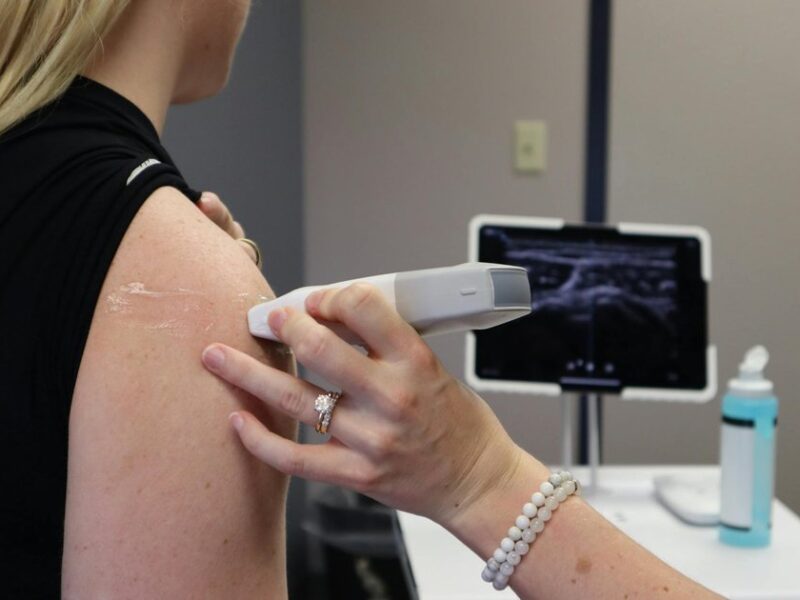
MIT researchers have unveiled an ultrasound wristband that captures intricate human hand movements, offering vital training data for humanoid robots. This breakthrough aims to enhance robotic dexterity, allowing machines to perform tasks that require fine motor skills, such as grasping objects or even performing surgery. The wristband uses high-frequency sound waves to visualize muscle and tendon movements beneath the skin, translating these into data that can teach robots to mimic human hand gestures with precision.
MIT’s Ultrasound Wristband Captures Human Hand Movements
The core technology of MIT’s wristband involves the use of high-frequency sound waves. These waves penetrate the skin to capture detailed images of the underlying muscles, tendons, and ligaments. This data is then processed by an AI algorithm that decodes the images into what engineers refer to as degrees of freedom—the specific ways a joint can bend or rotate. The human hand boasts 22 degrees of freedom, making it a complex system to replicate. Previous systems struggled to track even a fraction of these movements, but MIT’s wristband offers a comprehensive solution.
Achieving Human-Like Dexterity in Robots for Household Tasks
The data collected by the wristband is not just for academic interest; it has practical applications in enhancing robotic dexterity. Robots equipped with this data can perform complex household tasks with precision, such as picking up a cup or folding laundry. This capability is crucial for developing robots that can assist in everyday activities, reducing the need for human intervention in mundane tasks. The technology could also extend to other fields, such as surgical robotics, where precision and dexterity are paramount.
Real-Time Gesture Recognition: 120 Millisecond Response Time
One of the standout features of the wristband is its real-time data transmission capability. It can mirror hand gestures, including all 26 letters of American Sign Language, within just 120 milliseconds. This rapid response time allows for smooth interaction between humans and robots, enabling robots to mimic gestures almost instantaneously. The wristband operates wirelessly, meaning the user and the robot do not need to be in the same location, opening up possibilities for remote robotic operations.
The Future of Robotics: Building Large Datasets for Autonomous Learning
The potential of this wristband technology extends beyond immediate applications. By collecting extensive datasets of human hand movements, researchers aim to enable humanoid robots to learn dexterous tasks independently. This could lead to a future where robots can perform complex tasks without direct human guidance, relying instead on the vast amounts of data collected to inform their actions. Such advancements could change industries that require intricate manual tasks, from manufacturing to healthcare.
Frequently Asked Questions
How does the wristband technology work to capture hand movements?
The wristband uses high-frequency sound waves to penetrate the skin and capture images of muscles and tendons. These images are processed by an AI algorithm to decode the movements into degrees of freedom, which are then used to train robots to mimic human hand gestures.
What are the potential applications of this technology beyond household tasks?
Beyond household tasks, the technology could be applied in fields requiring precise hand movements, such as surgery. It could also be used in remote robotic operations, where the user and robot are not in the same location.
How does this development compare to previous methods of training robots for dexterity?
Previous methods struggled to track the complex movements of the human hand, which has 22 degrees of freedom. MIT’s wristband offers a comprehensive solution by capturing detailed images of muscle and tendon movements, allowing for more accurate and precise robot training.
Conclusion
The development of the ultrasound wristband by MIT researchers marks a significant advancement in the field of robotics. By providing detailed data on human hand movements, this technology paves the way for more capable and autonomous humanoid robots. As the technology evolves, it holds the promise of transforming industries that rely on manual dexterity, potentially leading to a future where robots can perform complex tasks independently. Apnews Report.

Trust Post Desk
A journalist and editor at TrustPost.org covering world and national news, technology updates and human-interest stories. They check every fact, interview sources in person or online, and aim to deliver clear, accurate reporting. Their work ranges from breaking news to in-depth features and daily newsletters. Outside the newsroom, they follow emerging trends and engage with readers on social media.