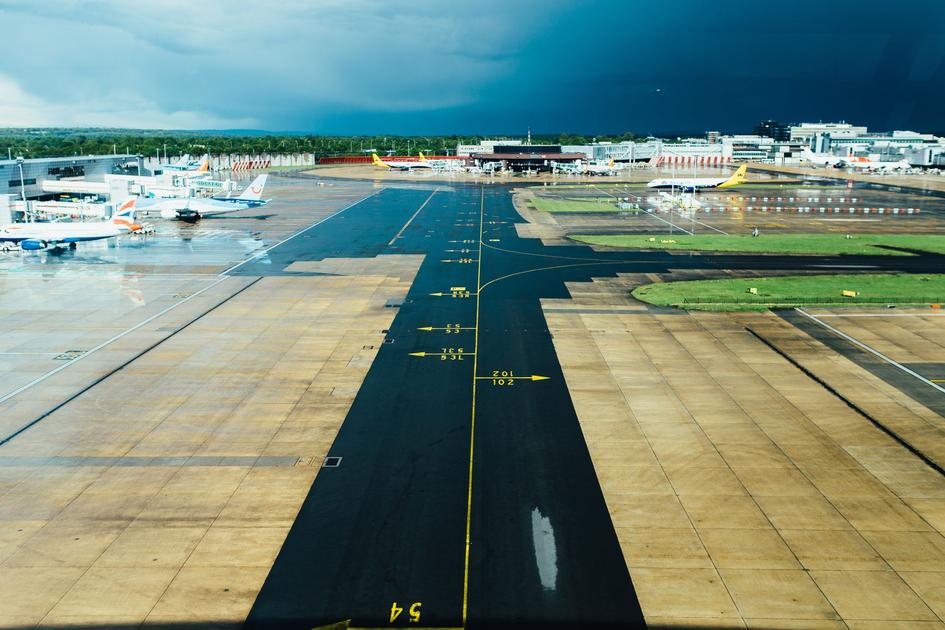
Iran’s Islamic Revolutionary Guard Corps launched missile and drone strikes against Kuwait International Airport on June 2-3, 2026, in one of the most significant
and symbolically provocative attacks of the Iran-US conflict that had been ongoing since February 28.
For more context, see our coverage of Trump and Qatar Air Force One Deal.
Key Developments
The strikes, which damaged airport infrastructure including a terminal building, runway lighting systems, and ground handling equipment, caused Kuwait International Airport to suspend all
operations for approximately 36 hours before partial service was restored under enhanced security measures.
Kuwait’s civil aviation authority diverted all inbound flights to Bahrain International Airport and Dubai International Airport during the closure, creating significant disruption across Gulf
Background and Context
For more context, see our coverage of US-India Trade Deal Latest Updates.
aviation networks that were already under strain from the broader regional conflict environment. Read also: World Cup 2026 June 19: USA vs Australia, Brazil
vs Haiti.
What Experts Are Saying
Related Articles
The attack on Kuwait’s main civilian airport was widely condemned across the Arab world, with Bahrain, Qatar, the UAE, and Saudi Arabia all issuing
For more context, see our coverage of US and Iran Sign Peace Framework.
statements characterizing the strike as a deliberate attack on civilian infrastructure that violated international humanitarian law.
The Kuwait airport strikes occurred despite Kuwait not having participated in the February 28 US-Israeli military action against Iran and despite Kuwait’s historically neutral posture in inter-Arab and regional disputes.
Iran framed the strikes as a response to Kuwait’s hosting of US military assets and logistics support that, Tehran claimed, had facilitated the February
28 strikes – a characterization that Kuwait’s government strongly rejected, noting that the presence of US forces in Kuwait operates under long-standing bilateral agreements
that predate the current conflict and do not constitute active participation in offensive military operations against Iran.
See also: World Cup 2026 June 18: Mexico, South Korea, Canada, Qatar.
The strikes represented a significant escalation of Iranian willingness to target civilian aviation infrastructure and GCC state territory in ways that pushed beyond the
parameters of the conflict as it had developed in the preceding weeks.
The Kuwait airport strikes had cascading effects on Gulf aviation beyond the immediate closure of Kuwait International Airport.
Several major international carriers that had maintained services to Kuwait through the earlier phases of the conflict suspended or rerouted their remaining flights to
the Gulf following the June 2-3 attacks, citing unacceptable security risk to aircraft and passengers.
Qatar Airways, Emirates, and flydubai each took actions to adjust their Gulf network operations in response to the strikes, reducing the frequency of services
and rerouting some flights that had been transiting Gulf airspace.
The Persian Gulf aviation hubs – Dubai International, Doha Hamad International, and Abu Dhabi – experienced significant operational pressure as passengers who had been on Kuwait-routed journeys sought alternative connections.
The economic cost of the aviation disruption, combined with the broader Hormuz shipping slowdown, contributed to the severe economic impact on Gulf states documented
in analyses of the conflict’s regional economic consequences.
The June 14 ceasefire MOU between the US and Iran explicitly addresses the naval blockade of Iranian ports but is expected to create the
broader security environment in which commercial aviation can return to normal operations across the Gulf region.
In the weeks following the June 2-3 strikes, Kuwait undertook emergency repairs to the damaged airport infrastructure and worked with aviation partners to restore full service capacity.
The speed of the recovery effort reflected both the economic imperative of restoring Kuwait’s connectivity – the airport is a critical hub for the
country’s trade, business travel, and large expatriate workforce – and the political significance for the Kuwaiti government of demonstrating resilience in the face of
Iranian military pressure.
At the diplomatic level, Kuwait filed formal protests with the United Nations Security Council over the airport strikes, joining a broader pattern of GCC
states using international legal and diplomatic channels to respond to Iranian actions rather than military escalation.
Kuwait’s response to the attacks illustrated the difficult position of smaller Gulf states caught between the US security framework they depend on for protection
and the Iranian military pressure that dependency invites.
Sources: Reuters – Ukraine | BBC News – Ukraine | NPR – Ukraine
Sources and Further Reading
Learn more at TechCrunch.
Learn more at The Verge.
Learn more at Wired.
Related Articles

Trust Post Desk
A journalist and editor at TrustPost.org covering world and national news, technology updates and human-interest stories. They check every fact, interview sources in person or online, and aim to deliver clear, accurate reporting. Their work ranges from breaking news to in-depth features and daily newsletters. Outside the newsroom, they follow emerging trends and engage with readers on social media.