If your car has wired Apple CarPlay but you’re tired of plugging in your iPhone every time you drive, a wireless Apple CarPlay adapter
is the solution. These small devices plug into your car’s USB port and convert your existing wired CarPlay system into a wireless one.
For more context, see our coverage of Cryptocurrency Market Update 2026.
You get all the same features—navigation, music, calls, and messages—without the cable.
This guide explains exactly what wireless CarPlay adapters are, how they work, which ones are worth buying, and whether you actually need one for your car.
A wireless Apple CarPlay adapter is a small plug-in device that adds wireless connectivity to cars that only have wired Apple CarPlay.
For more context, see our coverage of Climate Litigation 2026 Courts Around the World.
It works as a bridge between your iPhone and your car’s infotainment system.
What Is a Wireless Apple CarPlay Adapter?
Here’s how it works: The adapter plugs into your car’s USB port (the same one you’d normally use for the CarPlay cable).
It then creates a wireless connection to your iPhone via Bluetooth and Wi-Fi. Your car’s system thinks an iPhone is plugged in with a
For more context, see our coverage of Apple Becomes First $4 Trillion Company.
cable, but you’re actually connecting wirelessly.
The adapter doesn’t change what CarPlay can do—you still get the same maps, music apps, and phone features.
It just removes the need to physically plug in your phone every time you start the car.
Some newer cars come with wireless CarPlay built-in from the factory. If your car already supports wireless CarPlay, you don’t need an adapter.
Do You Already Have Wireless CarPlay?
To check if you already have wireless CarPlay:
If you have to plug in your iPhone to see CarPlay, then an adapter will upgrade your system to wireless.
Understanding the technical process helps explain why some adapters work better than others.
How Does a Wireless CarPlay Adapter Actually Work?
When you start your car with a wireless CarPlay adapter installed:
This entire process usually takes 5-15 seconds. The best adapters connect in under 10 seconds. Budget models can take 20-30 seconds or require manual reconnection.
Your setup must have three things:
The Connection Process
1. A car with factory wired Apple CarPlay – The adapter won’t add CarPlay to a car that doesn’t already have it. It only converts wired to wireless.
2. An iPhone running iOS 10 or newer – Older iPhones work, but iOS 14 or newer gives the best performance.
3. A working USB port – The port must be the same one your car uses for wired CarPlay, not just any USB charging port.
What You Need for It to Work
This is the biggest concern people have, and the answer depends on which adapter you buy.
Quality adapters use modern Wi-Fi chips that minimize lag. You’ll notice a 1-2 second delay when tapping navigation buttons or switching apps compared to
wired, but this is barely noticeable in real-world use.
Cheap adapters (usually under $40) often have:
Do Wireless CarPlay Adapters Have Lag or Connection Issues?
Premium adapters ($80-$150) typically have:
Connection quality also depends on:
Your car’s USB port location – If the port is in a closed compartment or glove box, the wireless signal may be weaker. Ports in the center console work best.
Connection Speed and Stability
Interference – Other wireless devices (garage door openers, toll transponders, radar detectors) can sometimes cause brief interruptions.
iPhone condition – Older iPhones with worn Bluetooth/Wi-Fi hardware may connect slower.
Most people find that a good-quality adapter feels almost identical to wired CarPlay after the initial connection.
Real-World Performance Factors
Not all adapters are equal. Here are the ones that consistently perform well based on compatibility, connection speed, and reliability.
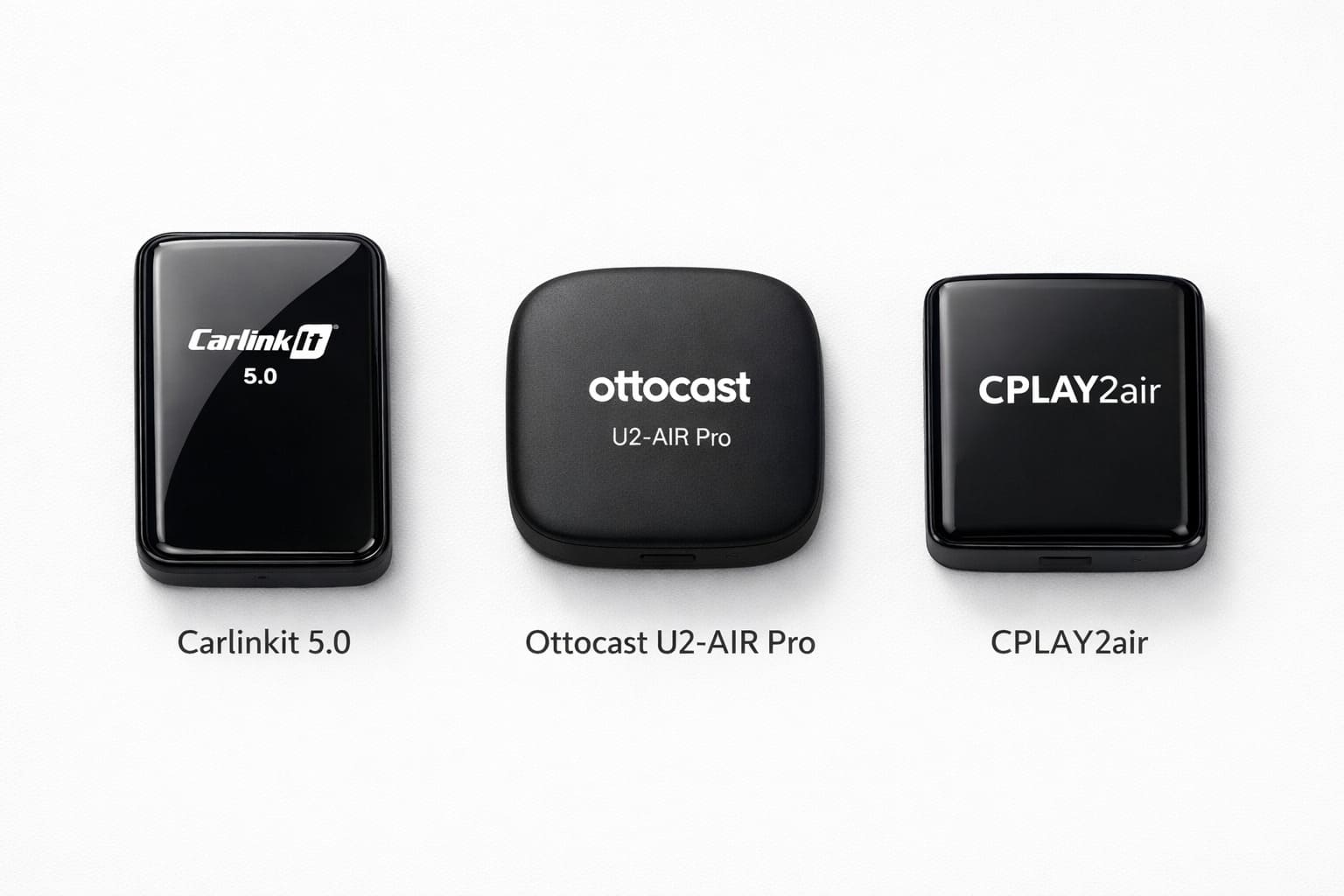
The Carlinkit 5.0 is one of the most reliable adapters on the market. It uses a newer chipset that connects in 7-10 seconds and
maintains stable connections even on long road trips.
It works with over 800 car models and supports both Apple CarPlay and Android Auto (if you switch phones). The build quality is solid, and customer support is responsive.
Which Wireless CarPlay Adapters Are Worth Buying?
The Ottocast U2-AIR Pro offers excellent performance at a lower price point. Connection time is around 10-12 seconds, which is acceptable for daily use.
It supports firmware updates to fix bugs and improve compatibility.
The main limitation is that it only works with Apple CarPlay—no Android Auto support if you ever switch to an Android phone.
The CPLAY2air is the original wireless adapter that started the trend. While newer models exist, this one still works reliably if you find it
on sale. Connection time is 15-20 seconds, slower than newer models but functional.
Premium Pick: Carlinkit 5.0 (AI Box)
It’s best suited for people who want to test wireless CarPlay without spending over $100.
Skip any adapter that:
Installation is straightforward and takes less than 2 minutes.
Best Value: Ottocast U2-AIR Pro
If CarPlay doesn’t appear:
Yes, but not as much as you might think.
Wireless CarPlay uses both Bluetooth and Wi-Fi, which consumes more power than a wired connection. However, the difference is manageable.
Budget Option: CPLAY2air (Original)
During a typical 30-minute commute with navigation and music:
On a longer 2-hour road trip with navigation:
If you take long trips and need your phone charged:
What to Avoid
1. Add a wireless charging mount – Most modern iPhones support wireless charging. A wireless charging phone mount in your car keeps your phone charged without cables.
2. Keep a Lightning cable handy – For road trips, you can plug in your phone even while using wireless CarPlay. The wired connection will charge faster than wireless.
3. Charge before you leave – Start trips with your phone at 80-100% battery, and wireless CarPlay won’t be an issue for most drives.
Comparison of Top Wireless CarPlay Adapters
For daily commutes under 45 minutes, battery drain is rarely a problem.
Compatibility is the most important factor before buying.
Wireless CarPlay adapters work with most cars that have factory wired CarPlay, but there are exceptions.
How to Install a Wireless CarPlay Adapter
Cars with known excellent compatibility:
Cars with potential issues:
Before buying, check the adapter manufacturer’s website for a compatibility list. Most sellers list supported car models in the product description.
Step-by-Step Installation
If you have an aftermarket stereo (Pioneer, Kenwood, Sony, etc.) with wired CarPlay, wireless adapters usually work well. However, very old aftermarket units from 2016-2017 may have compatibility issues.
Check the adapter’s compatibility list or contact the seller with your head unit model number.
Whether an adapter is worth buying depends on how often you use CarPlay and how much you value convenience.
Troubleshooting Tips
A wireless adapter makes sense if you:
You probably don’t need a wireless adapter if you:
At $100 average cost, you’re paying for convenience. If you drive 5 days a week, that’s about 260 times per year you avoid plugging
in a cable. For many people, the time and hassle saved is worth $100.
Does Wireless CarPlay Drain Your iPhone Battery Faster?
If you only use CarPlay once or twice a week, the benefit is less clear.
Yes, your iPhone doesn’t need to be visible or in a specific location. As long as it’s in the car and Bluetooth is on,
CarPlay will connect. You can leave your phone in your pocket, purse, or cup holder.
Yes, you can use other apps on your iPhone while CarPlay is active on your car’s screen.
However, CarPlay will interrupt if you get a call or navigation instruction. Some apps may not work properly if CarPlay is using them simultaneously.
Real-World Battery Impact
Wireless adapters don’t change which apps work with CarPlay—they only change how you connect. If an app works with wired CarPlay (Spotify, Apple Music,
Pandora, etc.), it will work with wireless CarPlay.
No, only one iPhone can connect to CarPlay at a time. However, the adapter can remember multiple phones.
When multiple phones are in the car, it usually connects to whichever one connected last or the one that pairs first.
Yes, your iPhone needs both Bluetooth and Wi-Fi enabled for wireless CarPlay to work. You don’t need to be connected to a Wi-Fi network—the
adapter creates its own direct Wi-Fi connection.
Solutions for Battery Drain
Rarely. Wi-Fi Direct operates on channels that avoid interference from regular Wi-Fi networks. You might notice brief interruptions in areas with extreme wireless congestion
(dense parking garages, stadiums), but this is uncommon in normal driving.
Most quality adapters (Carlinkit, Ottocast) support firmware updates. You typically update by connecting the adapter to a computer via USB or through a smartphone
app. Updates can fix bugs and add support for new car models or iPhones.
The wired connection takes priority. If you plug in your phone, CarPlay will disconnect from the wireless adapter and switch to wired mode.
When you unplug it, you’ll need to restart the car or manually reconnect to go back to wireless.
Will a Wireless Adapter Work With Your Car?
A wireless Apple CarPlay adapter is a simple upgrade that removes the daily hassle of plugging in your iPhone.
For most people with compatible cars, it’s a worthwhile purchase that makes every drive slightly more convenient.
The key is buying a quality adapter from a reputable brand. Spending $80-$140 on a reliable model like the Carlinkit 5.0 or Ottocast U2-AIR
Pro ensures you get fast connections, stable performance, and minimal troubleshooting.
Budget adapters under $50 often cause more frustration than they solve, with slow connections and reliability issues.
Check Your Car’s Compatibility
If you use CarPlay daily and drive a compatible car, a wireless adapter is one of those small upgrades that improves your routine in
a meaningful way. If you only use CarPlay occasionally or need to charge your phone from the USB port on long trips, keeping the
wired connection might make more sense.
Check your car’s compatibility, choose an adapter with good reviews, and enjoy the cable-free experience.
Also read:
Aftermarket Head Units
Sources and Further Reading
Learn more at TechCrunch.
Learn more at The Verge.
Learn more at Wired.
Related Articles

Trust Post Desk
A journalist and editor at TrustPost.org covering world and national news, technology updates and human-interest stories. They check every fact, interview sources in person or online, and aim to deliver clear, accurate reporting. Their work ranges from breaking news to in-depth features and daily newsletters. Outside the newsroom, they follow emerging trends and engage with readers on social media.