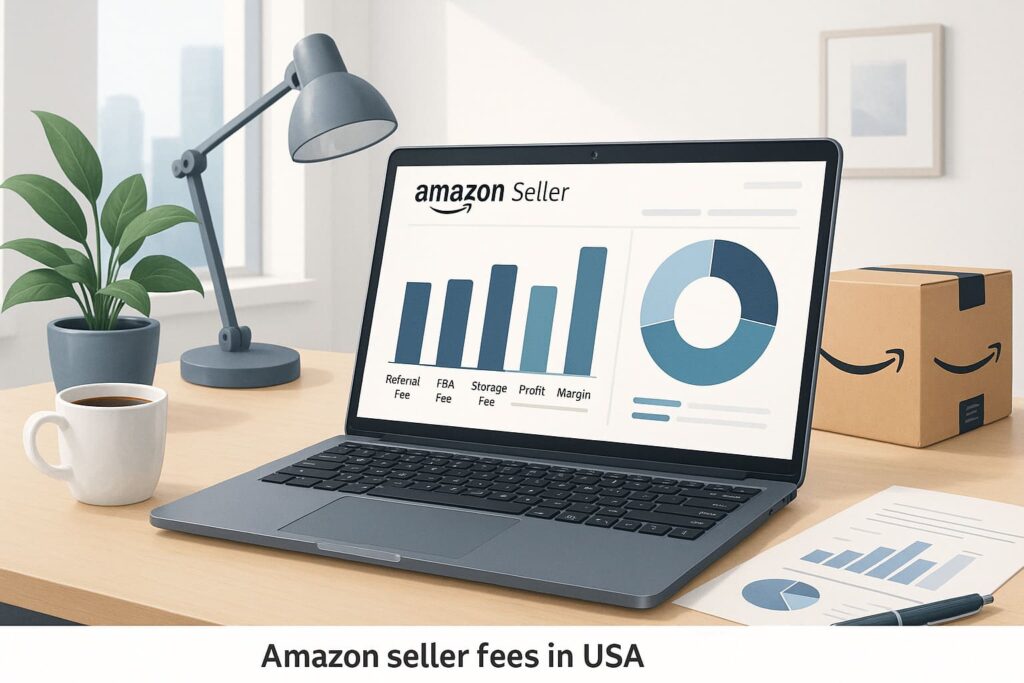
Most people fail on Amazon not because their product is bad, but because their math is wrong. They see sales. They see orders. They assume profit exists. Then they open a payout report and realize Amazon has quietly taken a massive share through a web of layered fees.
Amazon does not use one simple fee. It uses a stacked cost model. Some costs are fixed. Some are seasonal. Some punish slow inventory. Some punish unstable stock levels. Some only appear after refunds. If you do not map all of them before launch, your business turns into a volume machine with no margin.
This guide breaks down every active Amazon seller fee in the USA for 2025, using real pricing logic, real tables, and real profit math.
The First Cost Layer. Amazon Selling Plans
Before you sell even one unit, Amazon locks you into one of two cost structures.
The Individual plan has no monthly subscription, but Amazon charges $0.99 for every single unit sold. This plan restricts access to advertising, bulk uploads, brand-level tools, and advanced reporting. It is only logical if you sell fewer than about 30–40 units per month.
The Professional plan charges a flat $39.99 per month, with zero per-unit selling fee. This plan unlocks full ads, inventory tools, automation, reporting, brand content, and category approvals in many cases. Every serious seller in the US eventually runs on this plan because it protects margin at scale.
This fee does not replace any other Amazon fees. It simply sits at the top of the stack.
The Core Commission. Referral Fees on Every Sale
Amazon charges a referral fee on every order, no matter how the product is shipped. This fee is calculated as a percentage of the total order value, including item price and any shipping or gift wrap charged to the buyer.
For most standard retail categories, referral fees fall between 8% and 15%. Some categories go higher. A minimum referral fee of $0.30 per unit applies in many categories, which silently crushes margin on cheap items.
Common Referral Fee Benchmarks (USA)
| Category | Typical Referral Fee |
|---|---|
| Consumer Electronics | 8% |
| Home & Kitchen | 15% |
| Beauty & Personal Care | 15% |
| Toys & Games | 15% |
| Clothing & Apparel | 17% |
| Jewelry | 20% |
Some categories use tiered commissions. For example, a product may be charged 15% on the first $200 and 10% on the amount above $200. This system is common in large appliances, furniture, and select premium categories.
Low-priced apparel under $20 now carries lower referral percentages, which was introduced to make budget clothing workable on Amazon.
Because referral fees apply to both FBA and FBM orders, this fee is the foundation of Amazon’s revenue from your business.
Media Closing Fees and Per-Item Fees
If you operate on the Individual plan, the $0.99 per-item selling fee applies on top of referral fees.
If you sell media products such as books, DVDs, music, software, or video games, Amazon applies a $1.80 closing fee per unit. This is added on top of the referral fee.
If you rent textbooks, Amazon also charges a $5 rental service fee per transaction.
These charges look minor in isolation. On low-price products, they are often the difference between profit and loss.
The Structural Fork. FBA vs FBM
At this point, every seller must choose between two logistics paths.
With FBA (Fulfilled by Amazon), Amazon stores your goods, picks them, packs them, ships them, handles support, and processes returns. You pay for convenience through fulfillment, storage, inventory aging, return, and logistics redistribution fees.
With FBM (Fulfilled by Merchant), you control shipping and storage. You avoid Amazon warehouse fees but take on:
carrier costs, packaging materials, labor, warehouse rent or third-party logistics, and return freight.
FBA raises fixed system fees. FBM raises operational complexity and courier risk. Which one wins depends entirely on weight, size, return behavior, and product price.
FBA Fulfillment Fees. Pick, Pack, Ship, Support
FBA fulfillment fees cover: warehouse picking, packing, last-mile delivery, basic customer service, and return handling. These fees depend on item size tier and shipping weight.
Typical 2025 USA FBA Fulfillment Ranges
| Product Type | Approximate Fee per Unit |
|---|---|
| Small standard size | $3.20 – $4.00 |
| Large standard size | $4.50 – $7.80 |
| Oversize | $9.00 – $75.00+ |
Oversize and heavy products are the most dangerous category on Amazon. Sellers often see strong top-line revenue but collapse on fulfillment costs if pricing is weak.
If you use Multi-Channel Fulfillment to ship Shopify or website orders using Amazon’s warehouses, a completely separate fee card applies based on package size and delivery speed.
Monthly FBA Storage Fees
Amazon charges monthly storage fees based on the average cubic feet your inventory occupies per day.
Standard Storage Rate Structure
| Time Period | Standard Size Storage |
|---|---|
| January–September | $0.78 per cubic foot |
| October–December | $2.40 per cubic foot |
Peak season storage can triple your warehouse costs. Sellers who overstock for Q4 often feel profit erosion weeks after the sales rush ends.
Large bulky, hazardous goods, and special-handling inventory follow different storage rules.
Aged Inventory Surcharge (Long-Term Storage)
Inventory that sits too long in Amazon warehouses triggers an additional penalty fee.
- This begins after 181 days
- It intensifies after 365 days
Typical Surcharge Levels
| Inventory Age | Approximate Charge |
|---|---|
| 181–365 days | $0.50 – $5.90 per cubic foot |
| 365+ days | $6.90 per cubic foot or $0.15 per unit (whichever is higher) |
This fee converts slow inventory into a liability. It is one of the most common reasons sellers suddenly go negative without changing price or ads.
Inbound Placement Service Fees
When you ship inventory into Amazon, you are not necessarily sending it to the exact warehouse that will serve customers. Amazon redistributes stock across its network. That internal logistics now generates a direct inbound placement service fee.
Placement Logic
| Shipment Pattern | Fee Impact |
|---|---|
| One warehouse destination | Highest |
| Two to three warehouses | Moderate |
| Four or more warehouses | Lowest |
This fee is charged weeks after your shipment is received, which creates delayed cash-flow surprises for many sellers.
Some new product programs temporarily waive this fee for initial units.
Refunds, Returns, and Inventory Removal Costs
When a customer requests a refund, Amazon refunds most of your referral fee but keeps a refund administration fee, defined as the smaller of $5 or 20% of the referral fee.
Some categories also apply a return processing fee for FBA orders.
If you request inventory removal or disposal:
| Inventory Type | Typical Removal Cost |
|---|---|
| Small standard | $0.50 – $1.00 |
| Large standard | $1.00 – $3.00 |
| Oversize | $4.00 – $15.00+ |
Disposal is cheaper than removal but permanently destroys the product.
Amazon also charges unplanned prep fees for missing labels, incorrect packaging, barcode issues, or safety violations.
Low Inventory Level Fee
For standard-size FBA items, Amazon adds a low inventory level surcharge when your stock remains consistently below internal demand thresholds. This extra cost is applied per unit on top of the fulfillment fee.
This penalty exists because unstable inventory increases Amazon’s internal shipping and redistribution burden. Sellers running near zero stock often feel rising costs without realizing why.
High-Volume Listing Fee
Sellers holding very large catalogs with thousands of inactive listings may face a tiny per-listing fee. Individually minor, but meaningful at scale.
Advertising and System Add-On Costs
Sponsored Products, Brands, and Display ads are optional by policy but mandatory by competition in most niches. Advertising consumes 5% to 20% of gross revenue for most active sellers.
International sellers using non-US banks also face currency exchange spreads on payouts.
Programs such as Amazon Warehousing and Distribution and Supply Chain by Amazon add separate storage and transfer fees with partial relief on other charges.
A-to-Z claims and chargebacks exist but are low-frequency for quality sellers.
FBM Cost Reality
FBM avoids FBA storage and fulfillment fees but introduces: carrier shipping, boxes, padding, labels, labor, warehouse rent, third-party logistics, and return freight. FBM favors bulky products, fragile items, and personalized goods that do not fit efficiently into FBA fee tiers.
Real Profit Math. What Fees Actually Do to Your Revenue
Case 1. Standard FBA Product at $25
| Cost Layer | Amount |
|---|---|
| Referral fee (15%) | $3.75 |
| FBA fulfillment | $4.50 |
| Storage share | $0.30 |
| Amazon total | $8.55 |
| Remaining before product cost | $16.45 |
If your landed product cost plus returns exceed $16.45, you are already operating at risk.
Case 2. Oversize FBA Product at $150
| Cost Layer | Amount |
|---|---|
| Referral fee | $15.00 |
| Oversize fulfillment | $28.00 |
| Storage | $2.00 |
| Inbound placement | $3.00 |
| Amazon total | $48.00 |
That is 32% of revenue gone before ads or product cost.
Break-Even Pricing Logic
To survive Amazon’s system, most profitable products follow three rules:
- At least 3× markup over landed cost
- At least 30% gross margin before ads
- At least 12% margin after ads and returns
If your product cannot mathematically reach those levels, no ranking strategy can save it.
Final Verdict. The Truth About Amazon Fees
Amazon seller fees in the USA are not random charges. They are a designed economic system that rewards efficient logistics, fast inventory turnover, low return rates, and stable stock levels. Sellers who treat pricing casually bleed margin slowly. Sellers who model their full cost stack before launch stay in control.
Growth on Amazon is a math problem first. Marketing comes second.
Also read:
- What Is an Online Marketplace? Definition, Benefits & Top Examples
- How to Borrow Money from Cash App (Step-by-Step Guide)
- Cloud Storage and File-Sharing Services – Complete In-Depth Guide
- Best Antivirus Software for Windows, Mac, Android and iPhone
- 12 Best Team Collaboration Software Tools (2026 Guide)