Dubai often feels like a city without borders. Flights arrive from every direction, cultures mix effortlessly, and the skyline looks more futuristic than regional. Because of this global feel, a simple question regularly confuses people.
Which continent is Dubai actually in?
The answer is clear on a map, but the reason behind it explains a lot about how Dubai became one of the world’s most connected cities.
Dubai Is in Asia. Here’s the Simple Truth
Dubai is located on the continent of Asia.
More precisely, Dubai sits in Western Asia, on the Arabian Peninsula, as part of the United Arab Emirates. This places Dubai firmly within Asia from a geographic point of view, not just politically or culturally.
There is no debate among geographers. Dubai lies entirely on the Asian landmass.
So Why Does Dubai’s Continent Confuse So Many People?
The confusion comes from how Dubai is talked about, not where it is located.
Dubai is often described as being in the “Middle East.” That term sounds separate from continents, even though it is not one. The Middle East is a regional label, not a geographic continent. Most of the Middle East, including Dubai, falls inside Asia.
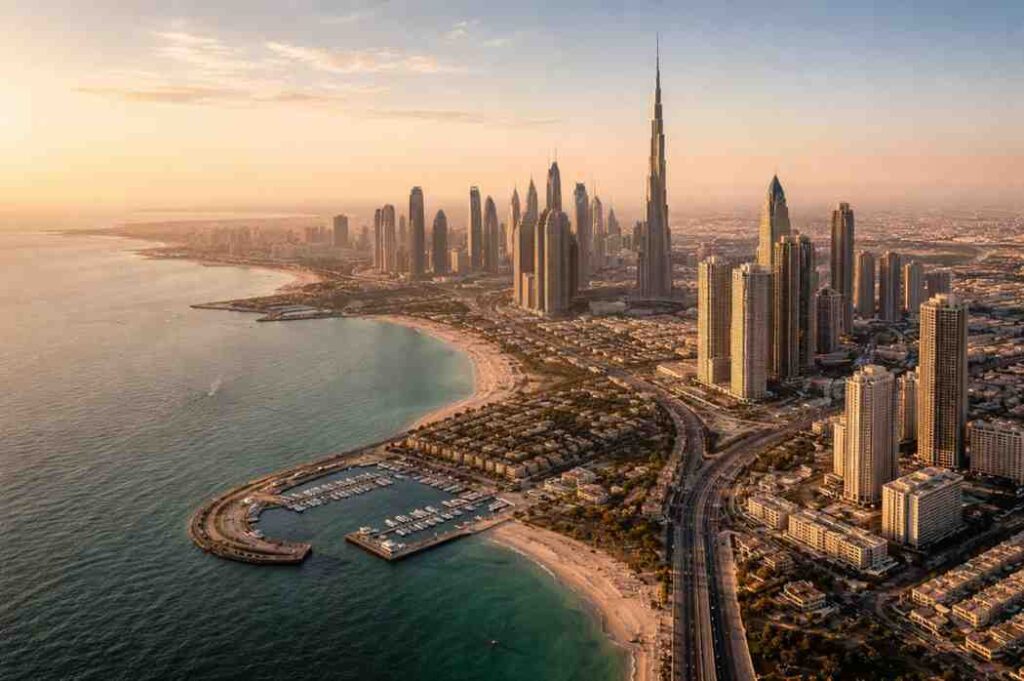
Add to that Dubai’s modern skyline, global business culture, and strong Western influence, and it stops feeling like what many people picture when they think of Asia. That mental gap causes the hesitation.
Where Exactly Is Dubai on the Map?
Dubai sits on the southeastern edge of the Arabian Peninsula. It faces the Persian Gulf and lies east of Africa and south of Europe, but it does not belong to either.
Geographically:
- Africa lies across the Red Sea
- Europe sits farther northwest
- Dubai rests fully within Asia’s boundaries
From a tectonic and landmass view, Dubai is Asian without overlap.
Why Dubai’s Asian Location Matters
Dubai’s position in Asia helps explain its rise.
Asia connects East and West. Dubai sits near major trade routes that have linked Asia, Africa, and Europe for centuries. Long before skyscrapers and luxury malls, this location supported trade, movement, and cultural exchange.
That same positioning now supports aviation, finance, tourism, and logistics. Dubai did not become global by accident. Geography played a quiet but powerful role.
Asia, But Not What People Expect
When people think of Asia, they often picture East Asia or South Asia first. Dubai challenges that narrow image.
Asia is huge. It includes deserts, megacities, coastlines, and ancient trade hubs. Dubai represents the western edge of this vast continent, where Arab culture, Asian geography, and global influence meet.
Understanding Dubai as Asian makes its diversity make more sense.
A Quick Way to Remember It
If you ever hesitate again, remember this:
- Dubai is part of the United Arab Emirates
- The UAE is on the Arabian Peninsula
- The Arabian Peninsula is in Asia
So the answer stays simple.
Dubai is in Asia.
Why This Question Keeps Showing Up
People don’t ask this because they failed geography. They ask because Dubai feels global rather than regional. It looks modern rather than traditional. It feels connected to everywhere rather than rooted in one place.
That feeling is real. But geography still grounds the city.
Dubai belongs to Asia, even as it reaches the world.
Also read:
- 20 Festivals in Ghana That Still Shape Culture Today
- How to Check Your MTN Number in Ghana (All Working Methods)
- What Is MVR in Baseball and Why It Matters
- Who Really Owns Fiji Water? The Story Behind the Famous Bottle