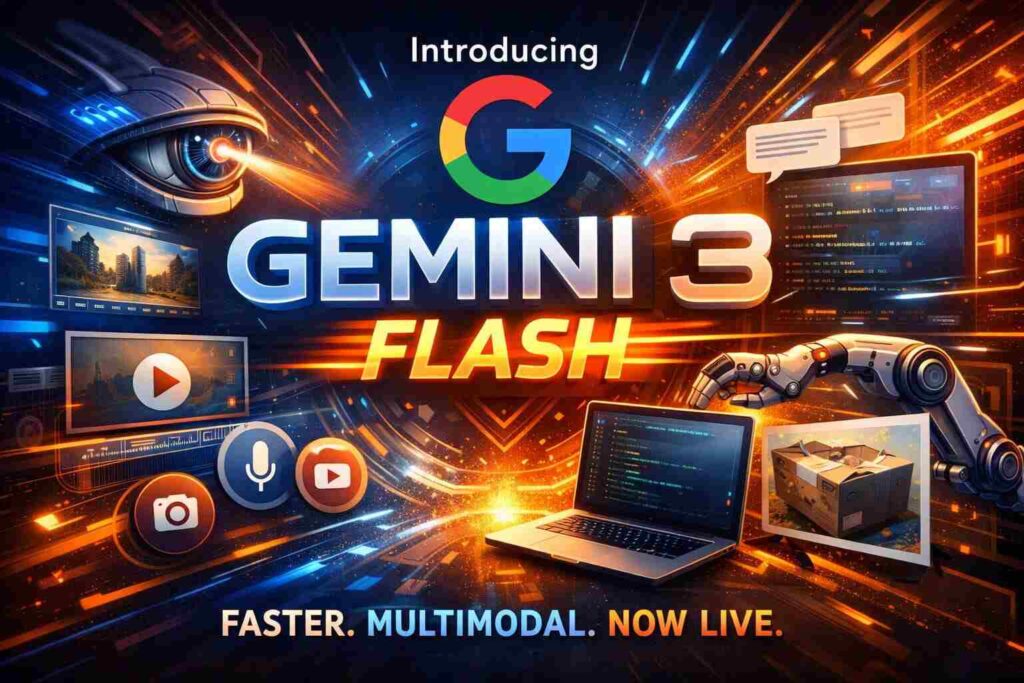
The AI landscape shifted dramatically today with Google’s surprise launch of Gemini 3 “Flash.” Unlike the staggered rollout of previous models, Google opted for a “flash” release, making the new model immediately available to developers and select partners.
This isn’t a full-fledged Gemini 3 Ultra release – that’s still slated for early 2026 – but a strategically positioned variant designed to redefine speed and efficiency in AI processing, particularly for multimodal applications. The move signals Google’s commitment to not just power, but accessibility in the rapidly evolving world of Large Language Models (LLMs).
What is Gemini 3 Flash? Key Details
Gemini 3 Flash isn’t about brute force computational power; it’s about intelligent optimization. Here’s a breakdown of the key takeaways:
- Speed is the Name of the Game: Google claims Flash is significantly faster than Gemini 1.5 Pro, and even outperforms GPT-4 Turbo in many speed benchmarks – particularly for shorter input/output tasks. This speed boost is achieved through a combination of model distillation and optimized architecture.
- Multimodal Mastery: Like its Gemini siblings, Flash excels at understanding and generating content across multiple modalities – text, images, audio, and video. However, Flash’s speed makes real-time multimodal interactions far more practical. Imagine instant image descriptions, rapid video summarization, or dynamic audio-based applications.
- Cost-Effectiveness: Faster processing translates directly into lower costs. Google is positioning Flash as an ideal solution for applications requiring high throughput at a reasonable price point. This is a crucial factor for wider adoption, especially for startups and smaller businesses.
- API Access & Integration: Gemini 3 Flash is immediately available through the Google AI Studio and Vertex AI platforms. This streamlined access allows developers to quickly integrate the model into existing and new applications.
- Model Sizes: Flash comes in a range of sizes, from 2B to 8B parameters, offering flexibility for different use cases and hardware constraints. This contrasts with the larger, more resource-intensive Ultra model expected next year.
Beyond Speed: The Multimodal Revolution Accelerates
The real story with Gemini 3 Flash isn’t just speed, it’s what that speed unlocks in the realm of multimodal AI. For the past year, we’ve seen impressive demos of LLMs understanding images and generating text. But the latency – the delay between input and output – has often been a barrier to truly interactive experiences.
Flash dramatically reduces that latency. Consider these potential applications:
- Real-Time Visual Assistance: Imagine a wearable device that instantly identifies objects in your field of vision and provides relevant information.
- Interactive Video Editing: Quickly generate different cuts of a video based on voice commands or automatically create summaries with key visual highlights.
- Enhanced Customer Service: AI agents that can analyze customer images (e.g., a damaged product) and provide immediate, personalized support.
- Accessibility Tools: Real-time audio descriptions of visual content for visually impaired users, delivered with minimal delay.
- Robotics & Automation: Faster processing of visual data allows robots to react more quickly and efficiently to their environment.
These scenarios, while previously possible in theory, become significantly more viable – and affordable – with the speed and efficiency of Gemini 3 Flash.
Why Google’s “Flash” Release Matters: A Strategic Play
Google’s decision to launch Flash as a surprise release is a calculated move. Here’s why:
- Countering OpenAI’s Momentum: OpenAI has maintained a strong lead in public perception. A quick, impactful release like Flash allows Google to demonstrate tangible progress and regain some ground.
- Developer Lock-In: By getting Flash into the hands of developers now, Google increases the likelihood that they’ll build their applications on the Google AI platform, making it harder to switch to competitors later.
- Data Collection & Refinement: Widespread use of Flash will generate valuable data that Google can use to further refine the model and prepare for the launch of Gemini 3 Ultra.
- Focus on Practical Applications: While Ultra aims for peak performance, Flash prioritizes real-world usability and cost-effectiveness. This demonstrates Google’s commitment to solving practical problems with AI.
- Setting the Stage for Ultra: The Flash release builds anticipation for the more powerful Gemini 3 Ultra, positioning it as the ultimate AI solution for complex tasks.
The Future is Fast and Multimodal
Gemini 3 Flash isn’t the final word in AI innovation, but it’s a significant step forward. It demonstrates that the future of AI isn’t just about bigger models, but about smarter, more efficient ones. The focus on speed and multimodal capabilities will unlock a new wave of AI-powered applications, making AI more accessible, affordable, and integrated into our daily lives.
The next few months will be crucial as developers begin to explore the full potential of Gemini 3 Flash. All eyes are now on Google as they prepare to unleash the full power of Gemini 3 Ultra in early 2026, promising an even more transformative impact on the world of artificial intelligence.
Also read:
- Best Antivirus Software for Windows, Mac, Android and iPhone
- Cloud Storage and File-Sharing Services – Complete In-Depth Guide
- Cloud Security Best Practices: Simple Ways to Keep Your Data Safe