
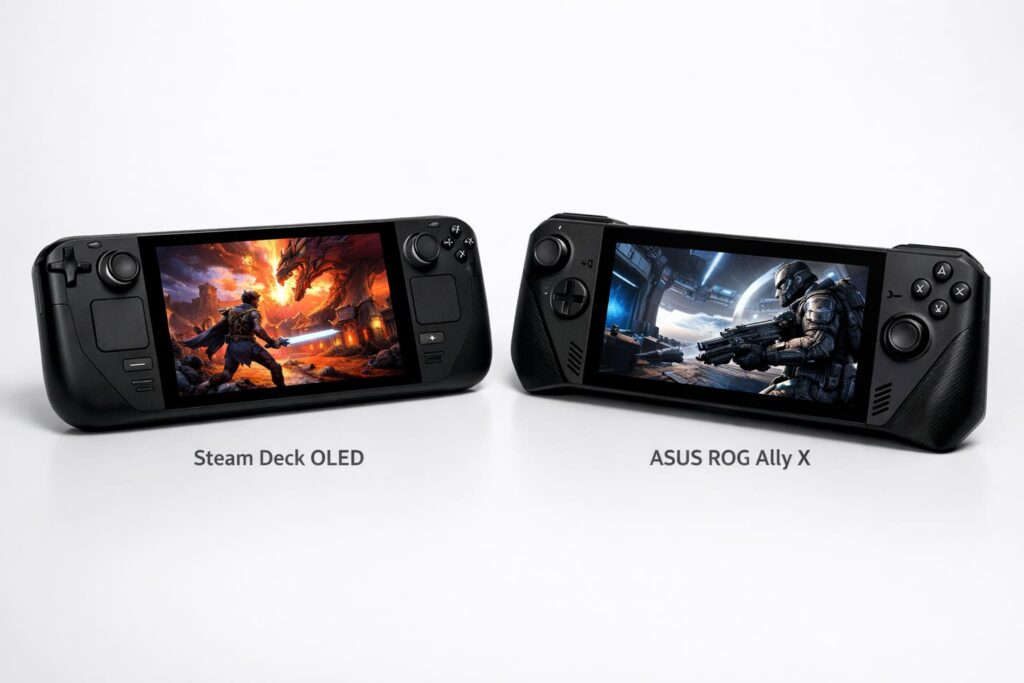
If you’re shopping for a gaming handheld in 2026, two devices consistently rise to the top: the Steam Deck OLED and the ASUS ROG
Ally X. Both can play PC games on the go, but they take very different approaches. The Steam Deck runs on SteamOS (a Linux-based
For more context, see our coverage of US-India Trade Deal Latest Updates.
system) and focuses on ease of use, while the ROG Ally X runs Windows 11 and prioritizes raw compatibility with every PC game launcher.
This guide breaks down the real-world differences between these two handhelds to help you make the right choice based on how you actually play games.
The Steam Deck OLED is Valve’s updated version of their original handheld PC. It keeps the same AMD processor but upgrades to a brighter
For more context, see our coverage of Climate Litigation 2026 Courts Around the World.
OLED screen, better battery, and refined design. It runs SteamOS, which means it’s optimized specifically for Steam games and works like a console right out of the box.
What Are the Steam Deck OLED and ASUS ROG Ally X?
The ASUS ROG Ally X is a refined version of ASUS’s first gaming handheld. It runs full Windows 11, which means you can install
For more context, see our coverage of Apple Becomes First $4 Trillion Company.
any PC game launcher—Steam, Epic Games Store, Xbox Game Pass, Battle.net, or anything else. ASUS doubled the battery size from the original Ally and increased the RAM to 24GB.
Both devices can play the same PC games, but the experience of using them day-to-day is completely different.
This is the most important difference between these devices, and it affects everything else.
Which Operating System Is Better: SteamOS or Windows 11?
The Steam Deck uses SteamOS, which is built specifically for gaming on a handheld. When you turn it on, you see your Steam library.
You press a button, the game downloads, and you play. There are no Windows updates, no antivirus pop-ups, and no driver installations.
The downside is that SteamOS runs a compatibility layer called Proton to play Windows games. Most games work perfectly, but some don’t run at all—especially competitive multiplayer games with anti-cheat software like Destiny 2, Fortnite, or Call of Duty.
The ROG Ally X runs the same Windows 11 you’d have on a desktop. This means every PC game works, including those that don’t run on Steam Deck. You can install Xbox Game Pass, EA App, or any launcher you want.
SteamOS: The Console-Like Experience
The tradeoff is that Windows wasn’t designed for a handheld. You’ll encounter desktop menus, keyboard pop-ups, and small text that’s hard to read on a 7-inch screen. ASUS includes their Armoury Crate software to make it easier, but it still feels less polished than SteamOS.
Which is better? If you only play Steam games and want a simple experience, SteamOS wins. If you need to play Game Pass titles or competitive shooters, Windows 11 is essential.
Both handhelds use AMD processors from the same generation, so performance is closer than you might expect.
Windows 11: Full PC Compatibility
The Steam Deck uses a custom AMD chip with 4 cores and 8 threads. It’s designed to run games at the native 1280×800 resolution.
Valve optimized SteamOS to squeeze every drop of performance from this chip, which means games often run smoother here than you’d expect from the specs alone.
In demanding games like Cyberpunk 2077 or Elden Ring, you can expect 30-40 FPS at medium settings.
Lighter games like Hades or Stardew Valley run at a locked 60 FPS or even 90 FPS on the OLED’s higher refresh display.
The ROG Ally X uses a newer chip with more powerful graphics. It can push games at the native 1920×1080 resolution and still maintain playable frame rates. The 24GB of RAM also helps in memory-intensive games.
How Do They Compare in Gaming Performance?
In the same demanding titles, the Ally X can hit 40-50 FPS at higher settings. It handles newer games like Starfield or Baldur’s Gate
3 with more headroom than the Steam Deck.
Real-world difference: The ROG Ally X is about 20-30% faster in most games. However, the Steam Deck’s lower resolution means it doesn’t need as much power to deliver smooth gameplay. For most games, both devices provide a good experience—the Ally X just does it at higher graphical settings.
Battery life matters more on a portable device than raw performance, and this is where the two devices differ significantly.
Steam Deck OLED: AMD Custom APU (Zen 2 + RDNA 2)
Valve upgraded the battery from 40Wh to 50Wh in the OLED model. Combined with the more efficient 6nm manufacturing process and SteamOS’s better power management, you get excellent battery life.
The OLED screen is also more power-efficient than the original LCD, which extends playtime even further.
ASUS doubled the battery from 40Wh to 80Wh in the Ally X. This is the largest battery in any mainstream gaming handheld.
Despite running Windows (which is less efficient than SteamOS), the sheer capacity gives you great results.
ASUS ROG Ally X: AMD Ryzen Z1 Extreme (Zen 4 + RDNA 3)
The reality: The Steam Deck OLED gets slightly better battery efficiency in lighter games because SteamOS manages power better.
However, for demanding AAA games, both devices drain in about the same 2-3 hour range. The Ally X’s massive battery gives you more total runtime in everyday use.
Both devices prioritize screen quality, but they use different technologies.
The Steam Deck OLED’s screen is its biggest upgrade. OLED technology means perfect blacks, vibrant colors, and HDR support.
The 90Hz refresh rate makes scrolling and fast-paced games feel smoother. Peak brightness reaches 1,000 nits, so you can play outdoors without struggling to see the screen.
Battery Life: Which Lasts Longer?
Games look stunning on this display. Dark scenes in horror games like Resident Evil Village have real depth, and colorful games like Spider-Man pop off the screen.
The Ally X uses a high-resolution LCD with a 120Hz refresh rate. The extra pixels make text sharper and small details easier to see.
Variable Refresh Rate (VRR) prevents screen tearing, which the Steam Deck lacks.
The LCD can’t match OLED’s contrast or color vibrancy, but it gets bright enough for most situations.
Steam Deck OLED: 50Wh Battery
Which looks better? The Steam Deck OLED has a more impressive visual impact because of the deep blacks and vibrant colors.
The Ally X has a sharper image because of the higher resolution. For games with detailed UI or text-heavy RPGs, the Ally X is easier to read. For cinematic games or anything with dark scenes, the Steam Deck OLED is noticeably better.
This is where the operating system choice becomes critical.
The Steam Deck can play most Steam games, but not all. Valve marks games as “Verified” (works perfectly), “Playable” (works but might have small issues), or “Unsupported” (doesn’t work).
ASUS ROG Ally X: 80Wh Battery
As of 2026, over 12,000 games are Verified or Playable. This includes major titles like Baldur’s Gate 3, Hogwarts Legacy, and Red Dead Redemption 2.
What doesn’t work:
You can install Windows on the Steam Deck if you want full compatibility, but then you lose the console-like experience that makes it great.
Display Quality: OLED vs LCD
The ROG Ally X runs Windows, so it plays everything a gaming PC can play. This includes:
The catch: Windows handhelds require more setup. You’ll need to install launchers, manage updates, and occasionally deal with desktop mode when something doesn’t work right.
Bottom line: If your library is on Steam and you don’t play competitive shooters, the Steam Deck covers you.
If you subscribe to Game Pass or play games across multiple launchers, the ROG Ally X is the only real option.
Steam Deck OLED: 7.4-inch, 1280×800, 90Hz, HDR OLED
Both devices are well-built, but they feel different in your hands.
The Steam Deck is the heavier device at 640 grams, but Valve shaped it so the weight sits in your palms.
The grips are chunky and comfortable for long sessions. The buttons and triggers feel premium with good travel.
The unique feature here is the dual trackpads under the thumbsticks. These make strategy games and mouse-based games like Civilization VI actually playable on a handheld.
ASUS ROG Ally X: 7-inch, 1920×1080, 120Hz, VRR LCD
The fan on the OLED model is quieter than the original, but you’ll still hear it during demanding games.
The Ally X weighs 678 grams, making it slightly heavier than the Steam Deck. ASUS redesigned the grips to be more ergonomic than the original Ally, and they added textured rubber for better grip.
The buttons are clicky and responsive. The back buttons are easier to reach than on the Steam Deck.
However, it lacks trackpads, which means mouse-based games require using the thumbsticks or touchscreen.
Game Library: What Can You Play on Each?
The fan can get loud under heavy load, but it’s manageable with headphones.
Preference: The Steam Deck feels better for 2+ hour sessions because of the grip design. The ROG Ally X is more compact and easier to fit in bags.
Price is often the deciding factor, and both devices have multiple configurations.
Steam Deck OLED Game Compatibility
The Steam Deck OLED costs less upfront, making it the better value if you’re on a budget. You can save money and use a microSD card for extra storage.
The ROG Ally X costs $150-$250 more but includes more RAM and the ability to play any PC game without workarounds.
If you subscribe to Xbox Game Pass ($16.99/month), that extra compatibility pays for itself over time.
Value winner: The Steam Deck OLED offers more for the money if you’re a Steam-focused gamer. The ROG Ally X justifies its higher price if you need Windows-only games or Game Pass.
ASUS ROG Ally X Game Compatibility
The answer depends entirely on how you play games and what you prioritize.
Yes, Valve officially supports Windows installation on the Steam Deck. However, doing this removes SteamOS and all its optimizations.
You’ll lose the quick resume feature, better battery management, and the console-like interface. Most people who want Windows should just buy the ROG Ally
X instead.
Technically yes, but ASUS doesn’t officially support it. There are community builds of SteamOS for the Ally X, but you’ll lose features like the
VRR display and may encounter driver issues. The device is designed around Windows.
Build Quality and Ergonomics
The ASUS ROG Ally X performs about 20-30% better in demanding AAA games because of its newer processor and higher RAM.
However, the Steam Deck’s lower resolution means it doesn’t need as much power to deliver smooth gameplay.
For the Steam Deck, the 512GB model is enough if you add a microSD card. Modern AAA games are 50-150GB each, so the 1TB model is better if you want to keep multiple large games installed. The ROG Ally X only comes in 1TB, which is good since
Windows takes up more space than SteamOS.
Yes, both can connect to TVs or monitors via USB-C. The Steam Deck supports up to 4K60 output.
The ROG Ally X also supports 4K60 and works with USB-C docks that include HDMI.
Steam Deck OLED
Both handle emulation well up to PS2 and Nintendo Switch generation. The Steam Deck has better community support for emulation because of the Linux base and active user community. The ROG Ally X has more raw power for demanding emulators.
Yes, both use M.2 2230 NVMe SSDs that you can replace yourself. ASUS makes it easier with a single screw access panel.
Valve requires more disassembly but provides guides. Both also support microSD cards up to 2TB.
There’s no universal “better” device between the Steam Deck OLED and ASUS ROG Ally X. They’re designed for different types of PC gamers.
ASUS ROG Ally X
The Steam Deck OLED is the best choice for most people. It’s cheaper, easier to use, has a stunning OLED screen, and provides excellent battery life for the majority of games. If your library is primarily on Steam and you don’t play competitive shooters, this is the smarter purchase.
The ASUS ROG Ally X is the enthusiast’s choice. You pay more money and deal with Windows quirks, but you get maximum compatibility with every PC game launcher, stronger performance, and the freedom to play anything without checking compatibility lists.
Both devices are excellent at what they do. Your decision should come down to one question: Do you value ease of use and value
(Steam Deck OLED) or do you value maximum compatibility and performance (ASUS ROG Ally X)?
Price Comparison: What Do You Get for Your Money?
Also read:
Sources and Further Reading
Learn more at TechCrunch.
Learn more at The Verge.
Learn more at Wired.
Related Articles
- US-India Trade Deal Latest Updates
- Climate Litigation 2026 Courts Around the World
- Apple Becomes First $4 Trillion Company

Get the TrustPost briefing
The stories that matter, in your inbox. No spam, unsubscribe anytime.
Newsletter signup will be available soon.
Related stories

Best Digital Signage Software: 8 Platforms Compared on Price and Features
Compare the best digital signage software in 2026. Verified per-screen pricing for Yodeck, OptiSigns, ScreenCloud, Rise Vision, Xibo and more.

The Best Karaoke Machines In 2026
The days of clunky CD-based karaoke machines are over. In 2026, the market is defined by high-definition touchscreens, AI-powered vocal removal, and wireless microphones with zero latency. Whether you’re turning your living…

Best Gaming Handhelds: The Ultimate Guide to Portable Consoles
The landscape of portable gaming has undergone a massive transformation. No longer confined to simple pixel art, today’s handhelds range from pocket-sized retro emulators to high-performance portable PCs capable of running the…