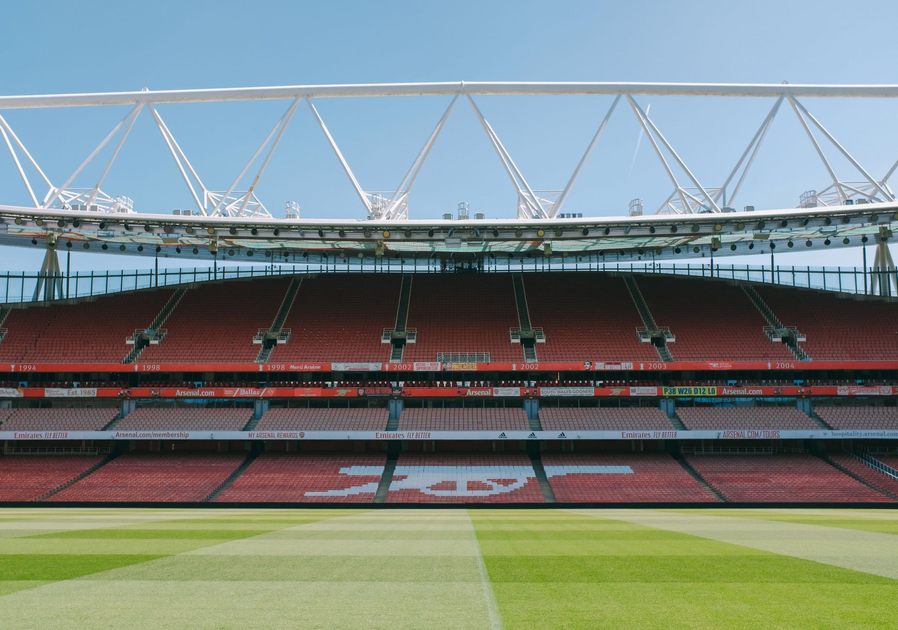
Arsenal Football Club have ended their 22-year wait for a Premier League title, clinching the championship on the final day of the 2025-26 season after Manchester City lost at home to Bournemouth, handing the Gunners the three points they needed from their own fixture to confirm what had seemed simultaneously inevitable and fragile throughout a season that tested the nerve of every Arsenal supporter in ways that the club’s previous title near-misses of 2023 and 2024 had prepared them for. The final table shows Arsenal finishing on 89 points, two ahead of Liverpool and four ahead of a Manchester City side that, for the first time in nearly a decade, finished a season without the Premier League trophy. North London erupted at the moment of confirmation on Sunday afternoon, and the scenes that followed were unlike anything the club’s fans have experienced in a generation.
The numbers that underpin Arsenal’s title tell the story of a team that improved in exactly the ways manager Mikel Arteta identified as necessary after the near-misses of the previous two campaigns. The Gunners conceded just 29 goals in 38 matches – the best defensive record in the league and an improvement of 11 goals conceded from their title-challenging season of 2023-24. Their xG against figure of 27.3 was even more impressive than the actual goals allowed, suggesting the defensive improvement was structural and systematic rather than dependent on goalkeeper heroics. Their points total in matches against the other top-six clubs was 22 from a possible 30 – a significant improvement from the 14 they had managed in the equivalent fixtures in their previous best season under Arteta.
The Key Players in Arsenal’s Title Win
- Bukayo Saka: 23 goals and 17 assists across all competitions, the most productive season of his career and a performance level that has moved him firmly into the conversation for the best winger in world football.
- Martin Odegaard: The captain’s leadership has been as important as his statistics (15 goals, 19 assists in all competitions). Arteta has spoken repeatedly about Odegaard’s ability to maintain the team’s focus and standards through difficult periods.
- David Raya: The goalkeeper’s save percentage of 79.3% was the highest of any goalkeeper with 20 or more appearances in the Premier League this season.
- Gabriel Magalhaes and William Saliba: The central defensive partnership has been described by multiple analysts as the best in the Premier League this season, combining physical dominance with composure in possession.
- Mikel Merino: The summer signing from Real Sociedad provided the physical defensive midfield presence that Arteta had sought for years, allowing the team a better platform to play out from the back against high-pressing opponents.
Arteta’s Evolution as a Manager
Mikel Arteta’s journey from assistant to Pep Guardiola to Premier League-winning manager in his own right is one of the most compelling coaching stories in English football in many years, and the manner of Arsenal’s title win reflects the evolution of his managerial philosophy through five seasons at the Emirates. The Arsenal of 2026 is recognisably built on the same high-press, positional play principles that Arteta brought from Manchester City, but it has developed tactical layers and in-game flexibility that the earlier versions of his Arsenal teams lacked. The ability to defend deep and absorb pressure when matches demand it – a capability that the Arsenal of 2022-23 clearly did not have – has been developed through a deliberate combination of tactical work and player additions whose skill sets enable that flexibility without sacrificing the attacking identity that makes Arsenal compelling to watch.
The comparison that Arteta’s most admiring observers are now drawing is not with his former mentor Guardiola but with the Arsene Wenger of the Invincibles era – a manager who built a team with a distinctive identity so deeply embedded in the players’ understanding that the team could perform at the highest level regardless of tactical variation from opponents. That comparison is premature after a single title, but the manner in which Arsenal won this championship – consistently, across a 38-game season, against every calibre of opponent – suggests a team that has become genuinely difficult to beat rather than one that is simply very good at the things it does well when conditions are favourable.
The Champions League Final
Arsenal’s Premier League triumph is accompanied by a Champions League final appearance on June 28, where they will face Paris Saint-Germain in Munich’s Allianz Arena – a fixture that represents the first time the club has reached the European Cup final since the Dennis Bergkamp era. The prospect of an English treble – Premier League, FA Cup (Arsenal won it in May) and Champions League – was discussed openly in the days following the title confirmation. While the magnitude of what would be required to beat a PSG side that has looked imposing throughout the European knockout rounds is not lost on Arteta or his squad, the confidence flowing through the club at this moment is of a different character than anything that has surrounded Arsenal during the false dawns and near-misses of the past decade.
Win or lose in Munich, this Premier League title changes Arsenal’s trajectory in fundamental ways. The combination of on-pitch success, Arteta’s continued presence (his contract runs through 2029), the Academy pipeline that continues to produce first-team contributors, and the financial resources that come with regular Champions League participation creates a platform that the club’s leadership believes can sustain a period of consistent challenge for the game’s highest honours rather than the intermittent near-misses that have defined the post-Wenger era. After 22 years, Arsenal are champions again. The next question is whether they can stay there.
Fan Reaction Around the World
The scenes in north London following the confirmation of Arsenal’s title were extraordinary, with tens of thousands of supporters gathering spontaneously at the Emirates Stadium and along Holloway Road in what became an unofficial street party that lasted through the night. Social media footage of Arsenal supporters in cities across the world celebrating the moment reflected the global reach of a club whose identity has been shaped as much by the beautiful football it played under Wenger as by the trophy cabinet those years produced.
For the generation of Arsenal supporters who grew up watching the near-misses of 2016, 2023 and 2024, Sunday’s confirmation carried an emotional weight that older supporters – those who remembered 2004 or 1998 – recognised from their own experience but could not fully share. Every fanbase has its own relationship with the wait between titles, and for Arsenal supporters who had endured decade after decade of watching the silverware go elsewhere while their team played beautiful, ultimately unsuccessful football, the moment of confirmation was the resolution of a story that had been building for most of their conscious lives as football fans. That release of emotion, visible in every face on every screen, was the most genuine and moving thing about a day that had no shortage of extraordinary moments.

Trust Post Desk
A journalist and editor at TrustPost.org covering world and national news, technology updates and human-interest stories. They check every fact, interview sources in person or online, and aim to deliver clear, accurate reporting. Their work ranges from breaking news to in-depth features and daily newsletters. Outside the newsroom, they follow emerging trends and engage with readers on social media.