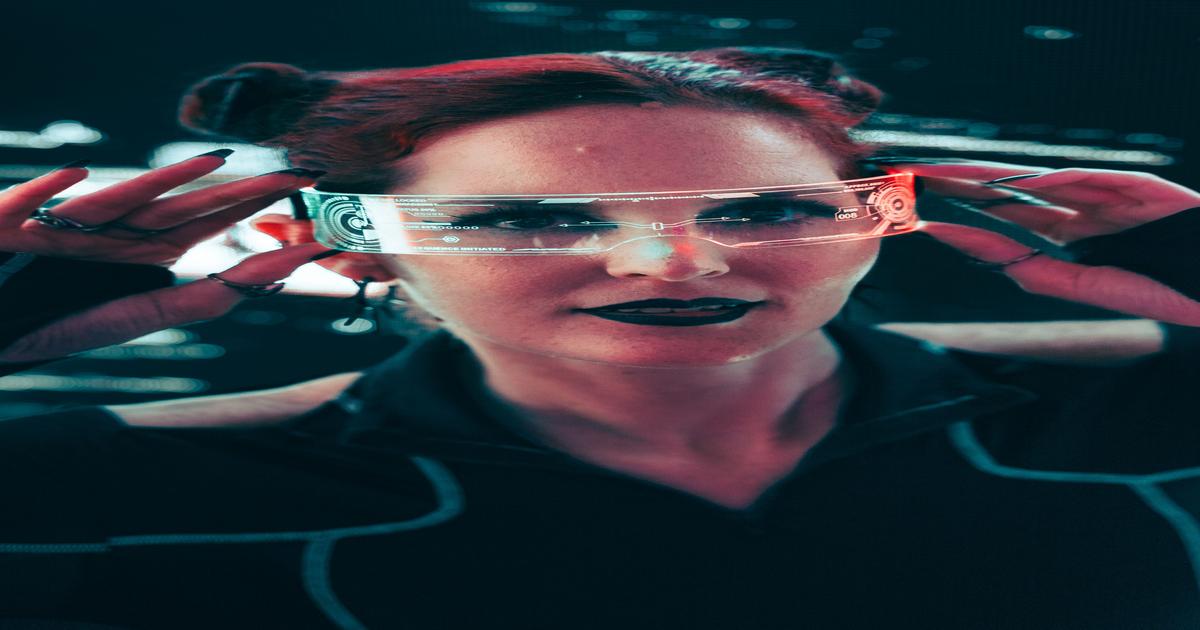
Meta launched the third generation of its Ray-Ban Meta smart glasses in June 2026, adding a heads-up display with a small transparent lens insert that overlays AI responses, navigation directions, and caller ID directly in the wearer’s line of sight.
The Ray-Ban Meta 3 starts at $399 and runs Meta AI powered by Llama 4, processing basic commands on-device and routing more complex tasks to Meta’s cloud servers. The display uses a waveguide lens insert developed with Carl Zeiss AG.
Meta CEO Mark Zuckerberg wore the glasses during a 45-minute demonstration in San Francisco, showing real-time language translation of spoken Spanish displayed as English text in the lens, navigation overlay while walking, and object identification by looking at items.
Display and Hardware
The heads-up display is a single-eye insert on the right lens that shows monochromatic amber text and simple graphics. It is not a full augmented reality overlay; it cannot show full-color images or video. Meta positioned this as a feature for battery life and wearability.
Battery life reaches 8 hours with the display used moderately, dropping to 4 hours with continuous active AI use. The glasses charge via a custom case that holds three additional full charges, giving up to 32 hours total away from an outlet.
The integrated 12-megapixel camera records 4K video and takes photos triggered by a button tap or the voice command “Hey Meta, take a photo.” Privacy indicators include an LED light visible to others when the camera is active.
AI Features and Meta AI Integration
Meta AI in the glasses can answer questions about what the wearer is looking at, translate foreign text seen through the camera in real time, identify plants and animals, read menus aloud for visually impaired users, and surface contact information for people recognized by the camera.
Live translation now covers 27 language pairs. When the wearer hears a foreign language, Meta AI transcribes and translates it, displaying the translation in the lens within 300 milliseconds. Outgoing speech translation through the glasses’ speakers was not available at launch.
Privacy groups including the Electronic Frontier Foundation flagged concerns about the facial recognition capability, which Meta said is off by default and requires explicit opt-in. The EFF noted that default settings frequently change after product launches.
Ray-Ban Meta Glasses Generation Comparison
| Feature | Gen 1 (2023) | Gen 2 (2024) | Gen 3 (2026) |
|---|---|---|---|
| Display | None | None | Amber HUD overlay |
| AI | Limited voice | Meta AI chat | Llama 4 on-device |
| Camera | 12MP | 12MP 4K video | 12MP 4K + live translation |
| Battery | 4 hrs | 6 hrs | 8 hrs + charging case |
| Price | $299 | $329 | $399 |
Frequently Asked Questions
Are the Ray-Ban Meta 3 glasses full AR glasses?
No. The Ray-Ban Meta 3 has a heads-up display that shows text and simple graphics in one eye, but it is not full augmented reality. It cannot overlay full-color holograms or complex graphics on the real world. Meta’s full AR glasses, called Orion, are still in development and not yet commercially available.
Do Ray-Ban Meta 3 glasses work with prescription lenses?
Yes. Meta offers prescription lens options in partnership with Ray-Ban’s optical network. The HUD display insert is compatible with standard prescription lenses but not with progressive or bifocal lenses at launch. Prescription HUD inserts are priced at an additional $100-150.
Can bystanders tell if the Ray-Ban Meta glasses are recording?
A white LED light on the frame illuminates when the camera is recording or taking a photo. The LED is visible from the front to alert bystanders. Meta says the LED cannot be disabled by software, though independent security researchers have noted the LED can be blocked physically.

Trust Post Desk
A journalist and editor at TrustPost.org covering world and national news, technology updates and human-interest stories. They check every fact, interview sources in person or online, and aim to deliver clear, accurate reporting. Their work ranges from breaking news to in-depth features and daily newsletters. Outside the newsroom, they follow emerging trends and engage with readers on social media.