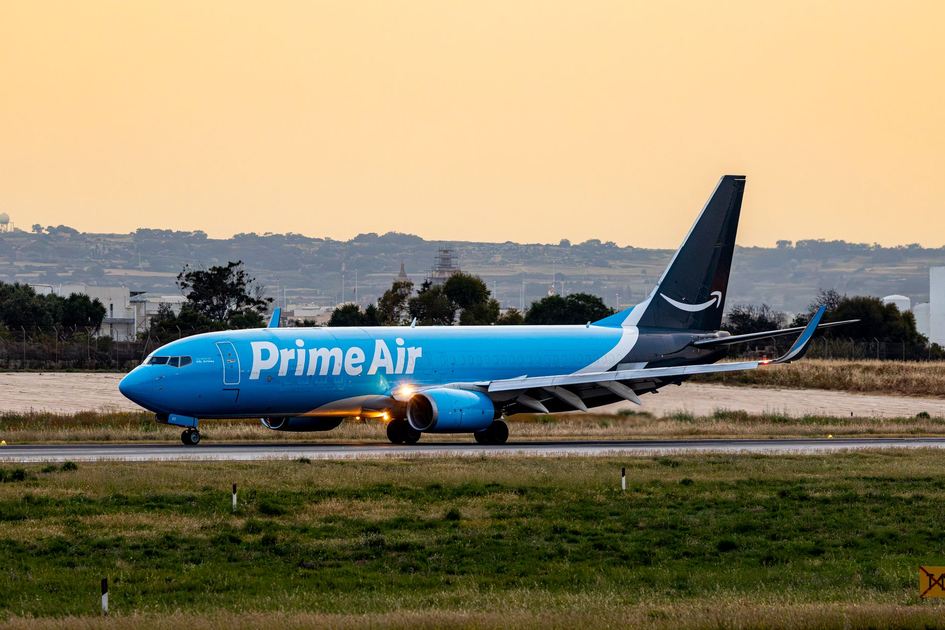
Amazon announced on Monday that it plans to expand its Prime Air drone delivery service to 50 US cities by the end of 2026, accelerating a rollout that has moved faster than regulators and industry observers expected after the FAA granted expanded operating authority to the company’s latest MK30 drone design. The expansion represents the most ambitious deployment of commercial drone delivery in US history and would put Amazon’s aerial delivery capability within reach of tens of millions of additional households.
The announcement came alongside the company’s confirmation that Prime Air is now operational in 12 cities across Texas, Arizona, Tennessee, and Georgia, with average delivery times of under 45 minutes for eligible items weighing up to 5 pounds. Amazon said the service has completed more than 500,000 deliveries to date, with a package damage rate below 0.1 percent and zero incidents involving injury to people or third-party property. The company cited these operational metrics as evidence that the technology is ready for a broader rollout.
The MK30 drone, which received FAA Beyond Visual Line of Sight approval in late 2025, represents a significant technical advance over earlier Prime Air designs. It can operate in light rain and wind conditions that grounded previous drone generations, has a range of 7.5 miles from the nearest fulfillment node, and incorporates multiple redundant safety systems including an autonomous landing abort capability that activates if the drone’s sensors detect a person or animal in the target delivery zone. CNBC reported that the MK30’s noise signature is approximately 40 percent lower than its predecessor, addressing one of the most common complaints from residents in pilot program areas.
The 50-city expansion plan targets suburban markets where the combination of available airspace, proximity to Amazon fulfillment infrastructure, and customer demand for rapid delivery creates the most favorable operating environment. Amazon said it would prioritize markets in the Sunbelt and Mountain West, where favorable weather conditions maximize the proportion of days on which drone delivery is operationally viable. The company declined to specify which cities would be added to the network, but said it would announce locations on a rolling basis as local regulatory approvals are secured.
The expansion puts pressure on competitors including Walmart, which operates its own drone delivery service in partnership with DroneUp across approximately 30 US markets, and Google’s Wing subsidiary, which has established operations in Texas, Virginia, and Minnesota. Bloomberg reported that Wing is also planning a significant expansion in 2026, and that the drone delivery market is entering a phase of competitive intensity that industry analysts expect to accelerate the buildout of aerial delivery infrastructure across the US.
The economic implications for Amazon are significant. Reuters cited internal Amazon projections suggesting that drone delivery, once at scale, could reduce last-mile delivery costs by up to 60 percent compared to traditional delivery vehicle routes in eligible suburban areas. At current volumes, the savings are not yet material relative to Amazon’s overall logistics spending, but at 50-city scale with the density of deliveries Amazon is projecting, the cost structure begins to become meaningful. Amazon has not provided specific financial projections for the Prime Air program publicly, but the scale of the investment in drone design, manufacturing and ground infrastructure makes clear that the company views last-mile aerial delivery as a long-term strategic priority rather than an experimental novelty.
Consumer response to Prime Air in operational markets has been broadly positive, with high reorder rates among customers who have used the service and survey data suggesting that same-day drone delivery is becoming a meaningful factor in Prime membership retention in areas where it is available. Amazon said that items most commonly delivered by drone include household essentials, over-the-counter medications, pet supplies and small electronics – precisely the categories where the speed advantage of drone delivery is most valued by customers and where the weight and size of products falls within the drone’s operating envelope.

Trust Post Desk
A journalist and editor at TrustPost.org covering world and national news, technology updates and human-interest stories. They check every fact, interview sources in person or online, and aim to deliver clear, accurate reporting. Their work ranges from breaking news to in-depth features and daily newsletters. Outside the newsroom, they follow emerging trends and engage with readers on social media.