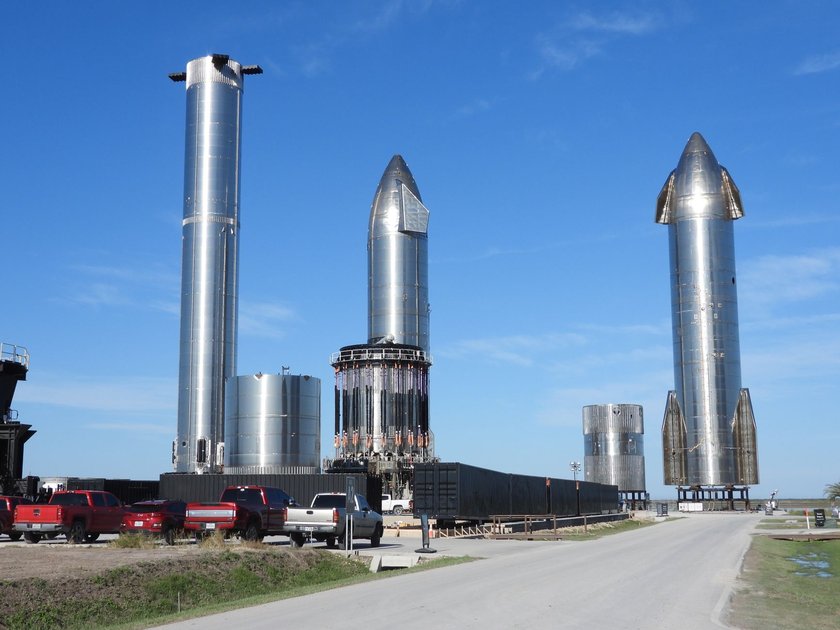
SpaceX’s Starship launch system successfully completed its first fully commercial satellite deployment mission on Sunday, placing 240 next-generation Starlink V3 satellites into low Earth orbit in a single launch from Starbase in South Texas. The mission, designated Starship Flight 12, marks the transition of the world’s largest and most powerful rocket from its development and demonstration phase to operational commercial service, a milestone that SpaceX CEO Elon Musk described as “the moment that changes the economics of access to space permanently.”
The 240 satellites deployed in a single Starship mission represent more than four times the payload capacity of SpaceX’s own Falcon 9 rocket, which has served as the workhorse of the Starlink constellation deployment and can carry approximately 53 Starlink satellites per launch. The Starlink V3 satellites deployed in Sunday’s mission are each significantly larger and more capable than previous generations, featuring higher-capacity laser inter-satellite links, greater throughput per satellite, and extended operational lifespans of approximately seven years. SpaceX said the satellites deployed in this single Starship mission will add approximately 12 terabits per second of additional capacity to the Starlink network once they reach operational orbit and become active.
The successful commercial deployment follows a development program that saw Starship complete its first fully successful end-to-end test flight – achieving orbit, completing a full reentry, and recovering both the Super Heavy booster and the Ship upper stage using the launch tower’s mechanical catch arms – in late 2025. That achievement cleared the regulatory path for commercial operations, with the FAA granting SpaceX a commercial launch license for Starship operations in February 2026 following an environmental review process that had been a source of significant delay in the program’s timeline. Bloomberg reported that SpaceX has a manifest of more than 30 Starship commercial missions scheduled for 2026 and 2027, including Starlink deployments, commercial satellite launches for third-party customers, and the first crewed Starship mission to the lunar surface under NASA’s Artemis program.
The cost economics of Starship are central to the program’s commercial significance. SpaceX has guided toward a launch cost target of approximately $10 million per Starship flight once the vehicle is operating at high cadence with full booster and ship reuse, compared to approximately $67 million per Falcon 9 launch and $350 million or more for competing expendable rockets from United Launch Alliance and Arianespace. At those projected costs, the price per kilogram to low Earth orbit would be dramatically lower than any current option, potentially enabling new commercial space applications that are economically infeasible at current launch prices. Reuters noted that the $10 million target remains aspirational and that current operating costs are significantly higher, but that each successful reuse of the booster and ship hardware moves the program closer to that economic goal.
The success of Flight 12 also validates SpaceX’s decision to pursue full and rapid reusability as the central design principle of the Starship architecture. The Super Heavy booster was caught by the launch tower’s Mechazilla arms for the third consecutive time, and the Ship upper stage performed a controlled water landing in the Indian Ocean in preparation for Ship reuse capabilities that SpaceX plans to demonstrate on subsequent flights. CNBC reported that the recovered booster from Flight 12 is scheduled to be reflown as soon as 72 hours after its recovery, which would set a new record for turnaround time between launches of an orbital-class rocket.

Trust Post Desk
A journalist and editor at TrustPost.org covering world and national news, technology updates and human-interest stories. They check every fact, interview sources in person or online, and aim to deliver clear, accurate reporting. Their work ranges from breaking news to in-depth features and daily newsletters. Outside the newsroom, they follow emerging trends and engage with readers on social media.