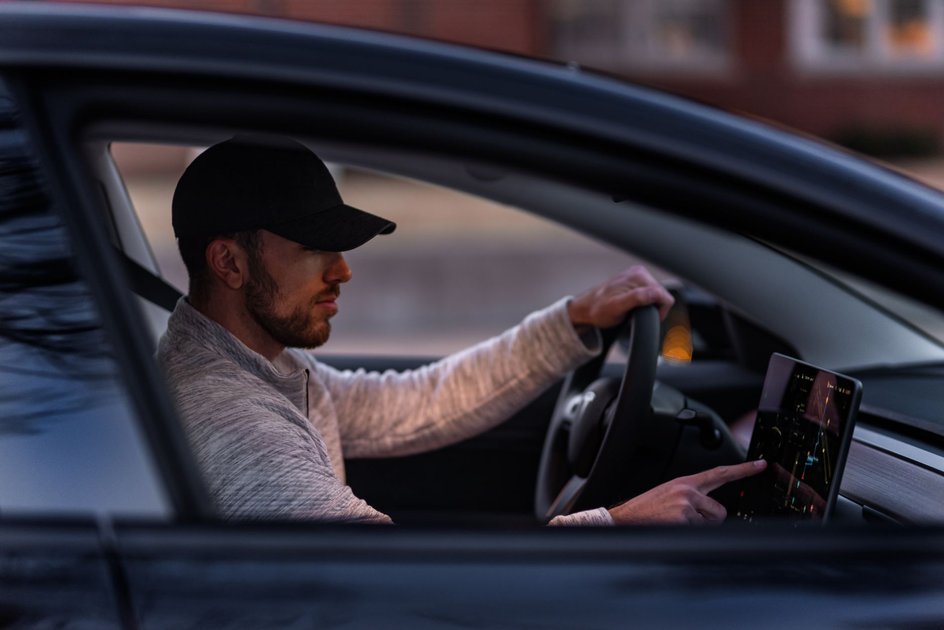
Tesla has officially confirmed that its long-awaited Robotaxi service, operating under the Cybercab brand, will begin limited commercial operations in Austin, Texas this summer – the first time the company will offer a fully autonomous, driverless ride-hailing service to paying members of the public. The announcement, made by CEO Elon Musk during Tesla’s Q2 2026 earnings call, represents the culmination of a development programme that began with the Autopilot system’s initial release in 2014 and has involved billions of dollars of investment, hundreds of millions of miles of real-world driving data collected from Tesla’s fleet, and more regulatory scrutiny than almost any technology product in the company’s history.
The Cybercab vehicle itself – a purpose-built two-passenger electric vehicle without a steering wheel, pedals or any manual driving controls – is physically unlike any car currently on public roads. Tesla began production of the Cybercab at its Gigafactory Texas facility in April, and Musk indicated during the earnings call that the company expects to have approximately 1,500 Cybercab vehicles operational in Austin by the end of the third quarter, with expansion to additional cities including San Francisco, Los Angeles and Miami planned for Q4 2026 and into 2027. The service will be accessed through the Tesla app, with pricing expected to be in the range of $0.20-$0.30 per mile – significantly below the cost of existing ride-hailing services and competitive with the cost of operating a personal vehicle for most urban users.
How the Technology Works
Tesla’s autonomous driving system, which the company calls Full Self-Driving (FSD) and has been deploying in increasingly capable versions on its consumer vehicles for years, uses a camera-only sensor approach that differs fundamentally from the lidar-dependent systems used by competitors including Waymo and Cruise. The company’s argument for the camera-only approach – which Musk has consistently championed against significant industry scepticism – is that human drivers navigate the world using only their eyes and a neural processing system, and that a sufficiently capable AI vision system should be able to match or exceed human driving ability using the same information sources. The Cybercab’s system uses 12 externally-mounted cameras providing 360-degree visibility, processed by a neural network running on Tesla’s custom FSD chip, with the decisions made by the AI system logged in real time and available for remote monitoring by Tesla’s operations centre.
- The Cybercab’s AI system processes approximately 144 frames per second from its 12 cameras, feeding into a neural network with over 1 billion parameters trained on data from Tesla’s global fleet of more than 6 million consumer vehicles.
- The vehicle communicates with Tesla’s operations centre via a 5G cellular connection, allowing remote human operators to monitor rides and intervene in unusual situations by instructing the vehicle to pull over safely.
- Tesla’s regulatory filings with the Texas Department of Motor Vehicles indicate that a human safety supervisor will be available remotely for every active Cybercab ride during the initial commercial rollout, a requirement that Austin city authorities insisted upon before granting the operating permit.
- The Cybercab charges at Tesla Supercharger stations autonomously, with self-directed routing to and from charging locations built into the vehicle’s operational software.
- Each Cybercab is equipped with an interior camera and microphone for passenger safety, with Tesla stating that recordings are encrypted and accessible only in the event of a reported safety incident.
The Regulatory Path to Austin
Securing regulatory approval for a commercial driverless vehicle service has been one of the most complex challenges Tesla has faced in bringing the Cybercab to market. The regulatory landscape for autonomous vehicles in the United States is a patchwork of federal guidelines and state-level legislation, with individual cities having significant authority over whether and how autonomous vehicle services can operate on their roads. Texas has been among the most permissive states for autonomous vehicle testing and commercial operation, having passed legislation in 2017 that largely deregulated autonomous vehicle operation on public roads and that has positioned the state as a preferred launch market for multiple autonomous vehicle companies.
The National Highway Traffic Safety Administration has been monitoring Tesla’s FSD system through an ongoing investigation that has examined multiple incidents involving the technology, and the launch of a commercial driverless service has intensified that oversight. NHTSA officials confirmed earlier this year that they have established a dedicated oversight programme for the Cybercab rollout that will include requirements for real-time data sharing from the commercial fleet and mandatory reporting of any incident involving property damage, injury or unusual system behaviour. Tesla has committed to these reporting requirements as a condition of its Austin operating permit, and the data generated by the Cybercab’s commercial operations will be among the most closely watched in the autonomous vehicle industry.
Waymo and the Competitive Landscape
Tesla’s Cybercab launch comes at a moment when the autonomous vehicle industry has consolidated significantly from the crowded field of competitors that existed five years ago. Waymo, the Alphabet subsidiary that began as the Google Self-Driving Car Project, has established the most mature commercial autonomous vehicle service currently operating in the United States, with driverless rides available to the public in San Francisco, Phoenix, Los Angeles and Austin. Waymo’s service uses a different sensor suite (cameras plus lidar plus radar), a different operational approach (geographically bounded service areas with detailed mapping) and a different vehicle platform than the Cybercab – differences that create a genuinely different product rather than a simple like-for-like competition.
The most important competitive question for Tesla is whether the Cybercab’s camera-only approach and its reliance on fleet-trained neural networks rather than high-definition map dependency can deliver the safety and reliability that commercial autonomous vehicle operation requires at a price point that Waymo’s sensor-heavy approach cannot match. Tesla’s cost structure for the Cybercab – lower hardware cost per vehicle, no lidar sensors, no HD mapping requirement – should give it a significant unit economics advantage if the technology performs as the company projects. Whether it performs as projected is a question that only the commercial operational data from the Austin launch will begin to answer definitively.
What Cybercab Means for Tesla’s Business
Musk has argued for years that the Robotaxi service will eventually become Tesla’s most valuable business, exceeding both its vehicle sales and its energy storage businesses in revenue and profit. The logic is straightforward: a fleet of autonomous vehicles that can provide rides 20 or more hours per day generates far more economic value per vehicle than one that sits parked 95% of the time as most personal vehicles do. If Tesla’s fleet economics work as projected – $0.25 per mile revenue, low per-mile operating cost, vehicles amortised over 500,000 miles or more – the long-term revenue potential is substantial. The investment community has been pricing in some probability of this scenario for years, which is one reason Tesla’s valuation has consistently exceeded what its current vehicle business alone would imply.
The more immediate question for investors and analysts is how quickly the Austin launch scales from 1,500 vehicles to the tens of thousands that would be needed to generate material revenue contribution. Tesla’s production capacity at Gigafactory Texas, its regulatory progress in additional markets, and the safety record established during the Austin operations will all be critical inputs to that scaling timeline. The summer of 2026 is the beginning of what could be the most consequential chapter in Tesla’s history – or another chapter in a story of ambitious projections that prove more difficult to execute than anticipated. By year’s end, the data from Austin will have begun to provide the first genuine evidence of which of those narratives is more accurate.
When Can You Use Cybercab?
For consumers eager to experience autonomous ride-hailing, the near-term availability will be limited to Austin residents and visitors who sign up through the Tesla app waitlist. Tesla has not announced a formal launch date beyond ‘summer 2026’ and has indicated that initial capacity will be limited as the company monitors safety performance and operational systems before scaling. The company plans to open the service to all Austin app users rather than requiring a Tesla vehicle ownership, positioning Cybercab as a standalone consumer product rather than a Tesla owner benefit. Pricing will be based on per-mile charges with no surge pricing during the initial launch period – a deliberate decision to build consumer trust by offering a predictable, affordable experience during the period when safety performance data is being collected and the service’s reputation is being established.

Trust Post Desk
A journalist and editor at TrustPost.org covering world and national news, technology updates and human-interest stories. They check every fact, interview sources in person or online, and aim to deliver clear, accurate reporting. Their work ranges from breaking news to in-depth features and daily newsletters. Outside the newsroom, they follow emerging trends and engage with readers on social media.